

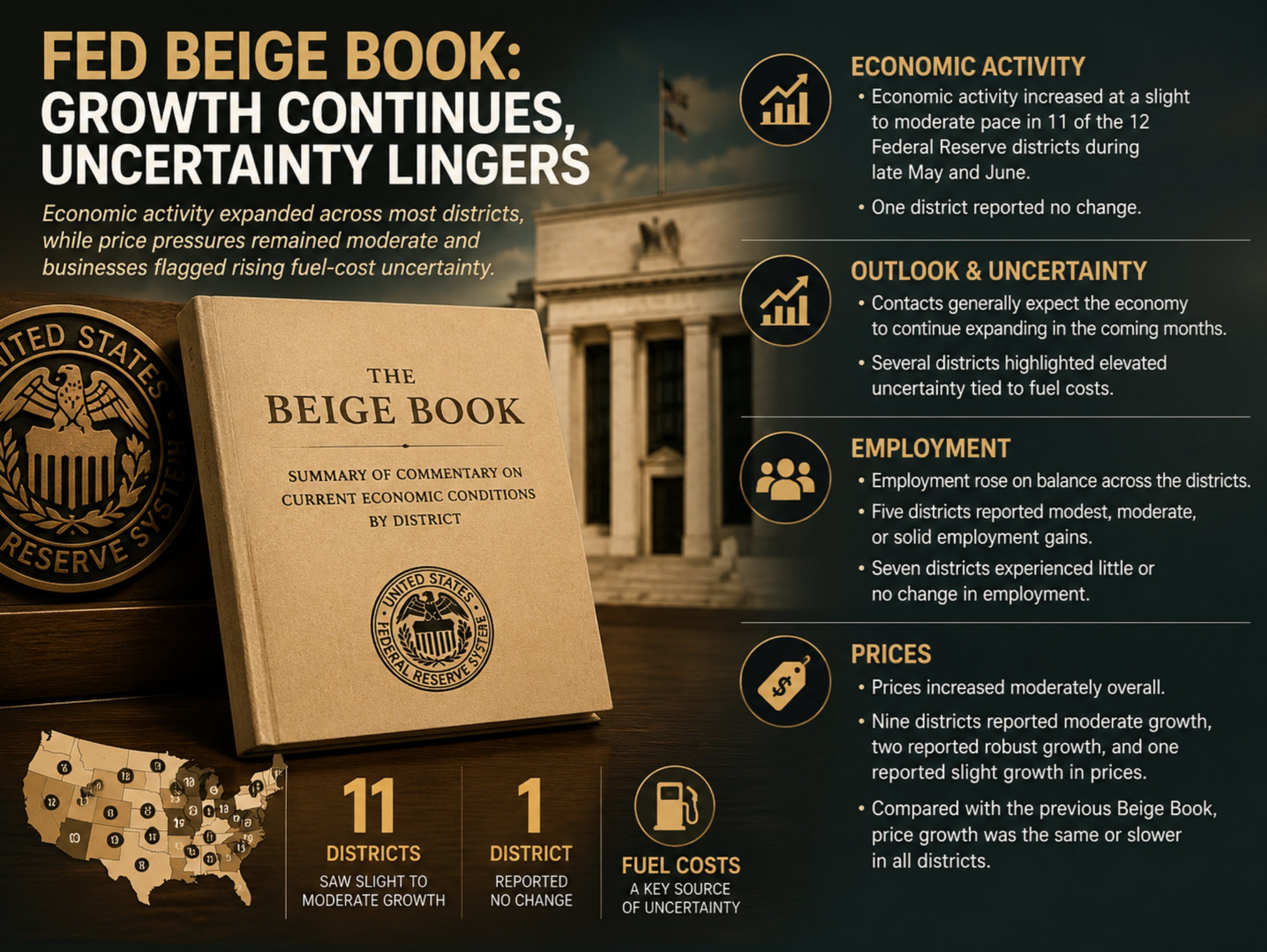
- Economic activity increased at a slight to moderate pace in 11 of the 12 Federal Reserve districts during late May and June.
- One district reported no change in economic activity.
- Contacts generally expect the economy to continue expanding in the coming months.
- Several districts highlighted elevated uncertainty tied to fuel costs.
- Employment rose on balance across the districts.
- Five districts reported modest, moderate, or solid employment gains.
- Seven districts experienced little or no change in employment.
- Prices increased moderately overall.
- Nine districts reported moderate growth, two reported robust growth, and one reported slight growth in prices.
- Compared with the previous Beige Book, price growth was the same or slower in all districts.
The Federal Reserve’s Beige Book painted a picture of an economy that continues to grow at a modest pace, but one that is facing a more uncertain outlook.
The Federal Reserve’s Beige Book is essentially a snapshot of how the U.S. economy is performing, based on what businesses, economists, bankers, and community leaders are seeing on the ground—not just government statistics.
Rather than relying on hard economic data like employment reports or inflation numbers, the Beige Book gathers anecdotal feedback from each of the Federal Reserve’s 12 regional districts. Businesses discuss topics such as hiring, wages, consumer spending, manufacturing, housing, commercial real estate, and pricing trends. The report is published eight times a year, about two weeks before each Federal Reserve policy meeting.
For investors, the Beige Book can provide early clues about the economy before official data are released. If businesses report stronger demand, rising wages, and increasing prices, it may reinforce expectations that the Fed will keep interest rates higher. Conversely, reports of slowing activity, weaker hiring, or easing price pressures can support expectations for lower rates or a more accommodative Fed.
In short, the Beige Book is the Fed’s “ground-level report card” on the economy, helping policymakers gauge economic conditions across the country before making interest rate decisions.
If you want to read the full text CLICK HERE.



Leave a Reply