

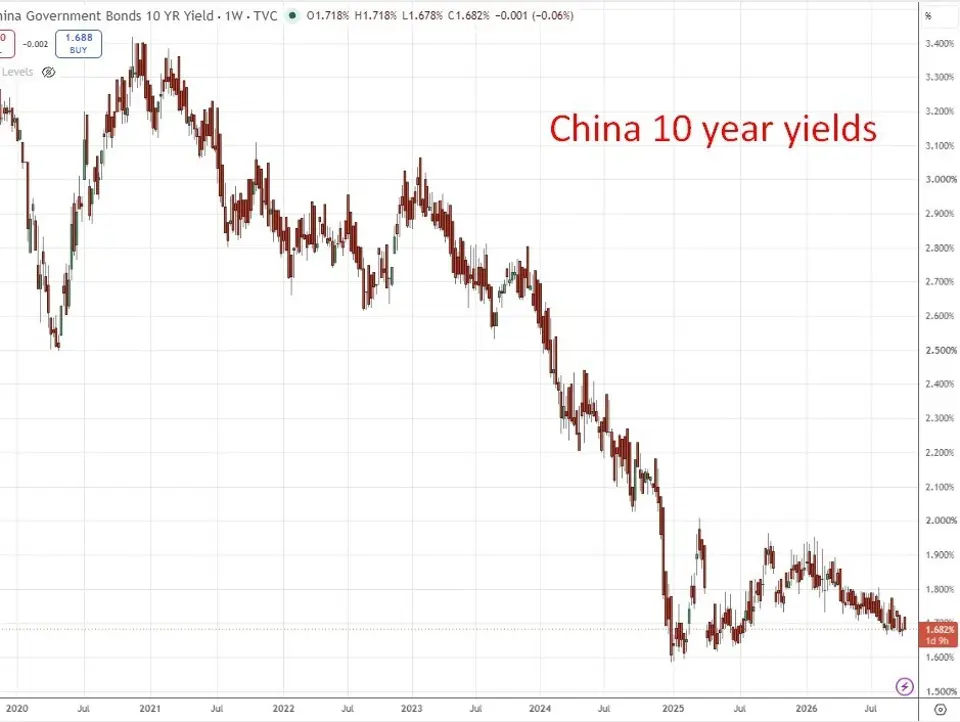
A gap of more than 3.5 percentage points between Chinese and US 10-year yields keeps downward pressure on the yuan and makes the currency attractive to borrow for carry trades, leaving the People’s Bank of China leaning on capital controls and its daily fixing to contain weakness. Central bank buying signals that Beijing is comfortable with low rates, so a policy-driven reversal in Chinese bonds looks unlikely while the domestic economy remains soft. For global markets, China is exporting disinflation rather than adding to the yield surge, and its banks’ appetite for government debt shows how little demand there is for credit. Any sign that savings are rotating from bonds into equities would be an important shift for mainland stocks.
—
—
While the rest of the world frets over soaring borrowing costs, China has the opposite problem: too much savings chasing too few places to put it.
Summary:
- China’s benchmark 10-year government bond yield has fallen to as low as 1.7%, more than 3 percentage points below the 5.3% yield on the equivalent US Treasury
- Chinese yields are also below those in the UK, France and even Japan
- Global yields are being pushed up by heavy government borrowing, war-driven energy inflation and AI-related demand for capital
- China’s economy is held back by weak consumption and a multiyear property slump, while exports are strong
- The People’s Bank of China has been a net buyer of bonds this year, a reversal from 2024, when Beijing planned bond sales to push yields higher
- Chinese banks held about 29 trillion yuan ($4.4 trillion) of bonds as of August, more than double their 2022 holdings
China’s government bond market is moving in the opposite direction to the rest of the world, with yields falling this year even as a global sell-off pushes borrowing costs to multi-decade highs elsewhere, the Wall Street Journal (gated) reported.
The yield on China’s benchmark 10-year government bond has fallen to as low as 1.7%, more than 3 percentage points below the 5.3% yield on the equivalent US Treasury note. Chinese yields also sit well below those in the UK and France, and even below Japan’s, long the standard example of ultralow rates. Economists at ING said China is going against the entire global trend.
Elsewhere, yields have been driven higher by surging government debt and the inflationary impact of the Iran war, which has lifted energy prices. Artificial intelligence is also playing a role, both by raising expectations for future growth and by drawing capital away from government bonds and towards AI developers and data centre builders.
China faces a different set of conditions. Exports are booming, but consumption is weak and the property market remains mired in a multiyear slump. Inflation has picked up but is less of a concern than in the US and other major economies.
Low yields carry their own risks. They reduce income for savers, who may then save more and spend less. They also send a downbeat signal about growth that can discourage hiring and investment, and they can push investors into riskier assets in search of returns.
Beijing’s stance has shifted markedly. As recently as 2024, policymakers were concerned enough about falling yields that they planned to sell government bonds to push them higher. This year, the People’s Bank of China has instead been a net buyer, suggesting it now views lower borrowing costs as helpful for weaker parts of the economy. One China economist said this showed officials were comfortable with lower yields.
Underlying the trend is a lack of alternatives for China’s large pool of savings. Capital controls keep household money at home, property is no longer a reliable store of wealth, and stock market returns have been poor over time. That leaves wealth management products heavily invested in bonds as a default option. Banks are even bigger buyers, building bond holdings to about 29 trillion yuan ($4.4 trillion) as of August, more than double their 2022 level, as loan demand stays weak. How quickly domestic demand recovers will determine whether that savings glut keeps pinning Chinese yields down.


Leave a Reply