

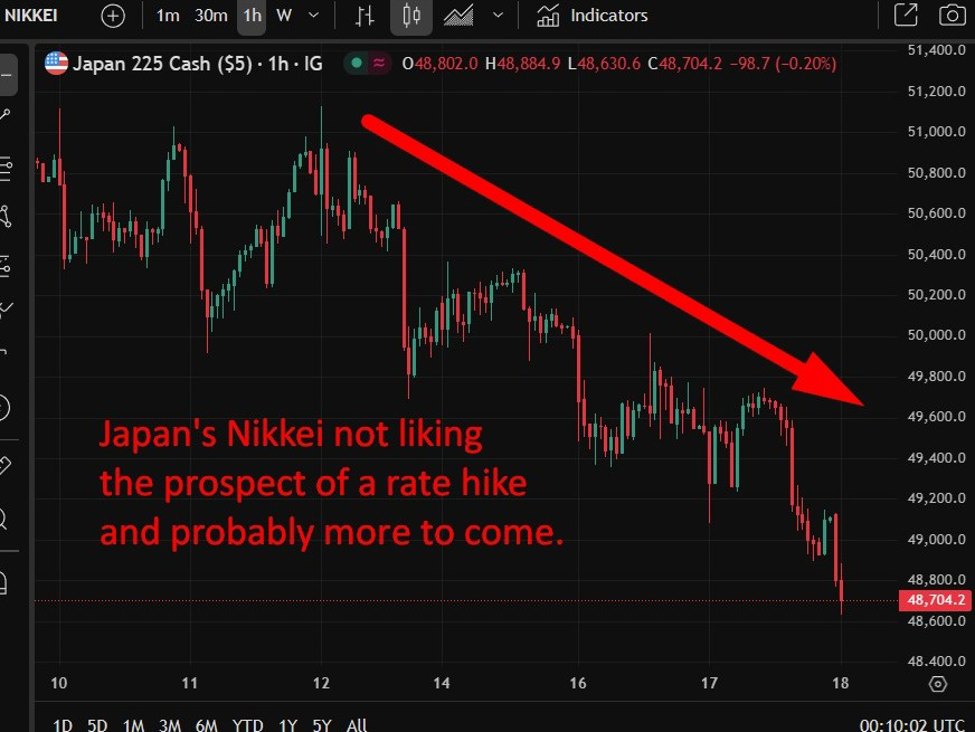
The Bank of Japan is expected to disappoint markets looking for clear guidance on the terminal rate when it concludes its two-day policy meeting on Friday, reinforcing the view that policy normalisation will remain cautious, conditional and highly data-dependent. Thats the view from Bank of America on the BoJ meeting today and tomorrow.
While a December rate hike is now broadly anticipated, attention will quickly turn to how Governor Kazuo Ueda frames the outlook. Markets are keen for clarity on how far the BoJ ultimately intends to lift rates, but officials are widely expected to resist providing explicit signals on the terminal level. Instead, the central bank is likely to reiterate its long-standing position that future moves will depend on how the economy and inflation respond to previous hikes.
This reluctance reflects both uncertainty around Japan’s underlying inflation dynamics and growing sensitivity to financial market conditions. Recent increases in Japanese government bond yields have sharpened concerns about tightening financial conditions too quickly, particularly given Japan’s still-fragile domestic demand recovery. Even after the expected hike, real interest rates are set to remain negative, underscoring the BoJ’s preference for gradualism rather than a predefined hiking path.
Currency dynamics remain a key risk factor. While the BoJ has downplayed the yen’s role as a direct policy target, officials are acutely aware that sharp exchange-rate moves can feed into inflation expectations and public confidence. Should the yen weaken rapidly following the meeting or early in the new year, pressure could build for policymakers to accelerate the pace of tightening. I posted on this earlier:
In that scenario, expectations for the next rate increase could be pulled forward. While the current baseline among many investors centres on a mid-to-late 2026 follow-up move, renewed yen depreciation could shift the timing toward April 2026, particularly if inflation proves resilient and wage growth remains firm.
For now, the BoJ is expected to stick to a deliberately vague framework: emphasising patience, monitoring incoming data, and avoiding any commitment to a terminal rate. That approach may frustrate markets seeking certainty, but it preserves flexibility at a time when both domestic and global conditions remain fluid.




Leave a Reply