

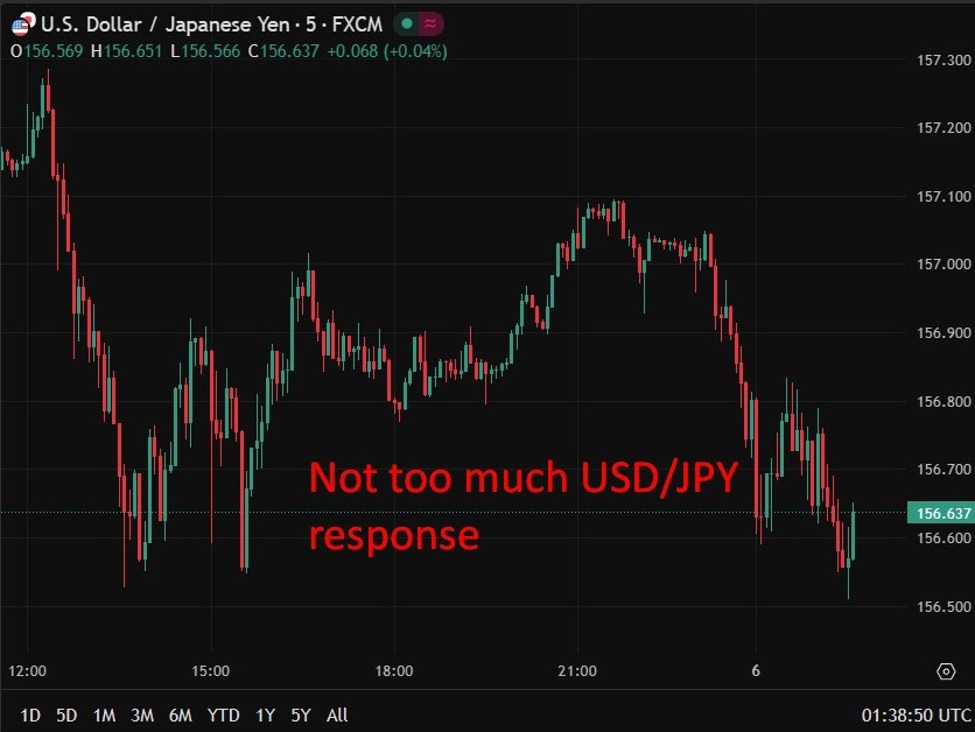
Masu said Japan is firmly in an inflationary phase and policy will keep normalising if the outlook holds, but the boj will move cautiously to protect the wage–price cycle while continuing balance-sheet tapering.
Full text can be read here:
Summary
-
BoJ board member Masu said Japan’s economy has so far weathered the US tariff shock better than feared, with tariffs “winding down” and little visible disruption to domestic activity.
-
He argued Japan has “fully transitioned into inflation”, but expects CPI to slow below 2% in H1 2026 as food-price effects fade and government measures bite.
-
Masu flagged food, especially rice and spillovers into broader processed food, as the key inflation risk to watch, more so than services inflation.
-
On policy, he said the BoJ has exited extraordinary easing, delivered four rate hikes since March 2024, held steady in January 2026, and will keep raising rates if the January outlook is realised, but cautiously to avoid breaking the wage–price cycle.
-
He also addressed balance-sheet normalisation: ETF disposal guidelines were set in September 2025, while JGB purchases are being tapered sharply and holdings reduced, with purchases seen falling to under JPY30trn by FY2027.
–
Bank of Japan board member Kazuyuki Masu struck a cautiously hawkish tone in a speech in Ehime, arguing Japan has moved decisively out of deflation while warning policymakers must navigate the final stage of normalisation carefully to avoid damaging a nascent wage–price cycle.
Masu opened by flagging two key risks the BoJ is monitoring: the global spillovers from US tariff policy and the durability of Japan’s inflation dynamics. On trade, he said the tariff issue that has weighed on global sentiment since 2025 appears to be “winding down” without causing significant disruption to Japan, aided in part by yen depreciation supporting exporters’ earnings even as auto tariffs rose. He pointed to firm US consumption and labour-market conditions as an offset to earlier fears of a broader slowdown.
On inflation, Masu said Japan has “fully transitioned into inflation”, with CPI running above 2%, but he expects the headline pace to decelerate to below 2% in the first half of 2026 as the impact of earlier food price rises wanes and government measures to address rising prices take effect. He singled out food as the dominant driver, noting the 2025 surge in rice prices and emphasising the risk that rice-driven price psychology spills into broader processed food inflation, a channel he is watching closely.
Masu also addressed the yen, noting that currency weakness has been a double-edged influence on the economy. While a weaker yen has supported corporate profits and exporters’ earnings, he acknowledged that it has also contributed to imported inflation, particularly through higher food and energy costs. He stressed that the BoJ is closely monitoring the extent to which exchange-rate moves feed through into prices and inflation expectations, especially given the sensitivity of household sentiment. Masu reiterated that excessive or disorderly currency moves are undesirable, and said exchange-rate developments remain an important consideration in assessing the balance between sustaining growth and containing inflation pressures.
Masu’s comments keep USD/JPY sensitive to inflation persistence and yen pass-through, reinforcing the risk that further BoJ normalisation, alongside Ministry of Finance vigilance, caps tolerance for renewed currency weakness.
Masu also spent time on rates and “room to move”. He noted the policy rate was lifted to 0.75% in December 2025, but argued real interest rates remain materially negative, meaning financial conditions are still accommodative. He discussed the neutral-rate concept, citing estimates that imply a nominal neutral range roughly around 1.0–2.5%, while stressing the uncertainty around any single point estimate.
On the policy path, Masu said the BoJ has exited unprecedented easing, implemented four rate hikes since March 2024, and held rates in January 2026 to monitor data. If the January outlook for activity and prices is realised, he said the boj will continue to raise the policy rate and adjust accommodation as it completes normalisation, but he warned against excessive tightening that could disrupt the “virtuous cycle” of wages and prices.
Finally, Masu detailed balance-sheet normalisation. He noted the BoJ decided on ETF disposal guidelines in September 2025, and argued sales must be paced carefully given the scale of holdings. On JGBs, he highlighted the boj holds about half of outstanding supply and is reducing purchases to support market stability, with annual buying set to fall from a peak above JPY130trn to slightly under JPY30trn by FY2027, while JGB holdings are projected to fall by nearly 20% by March 2027.
Masu is a former chief financial officer of trading house Mitsubishi Corp.


Leave a Reply