

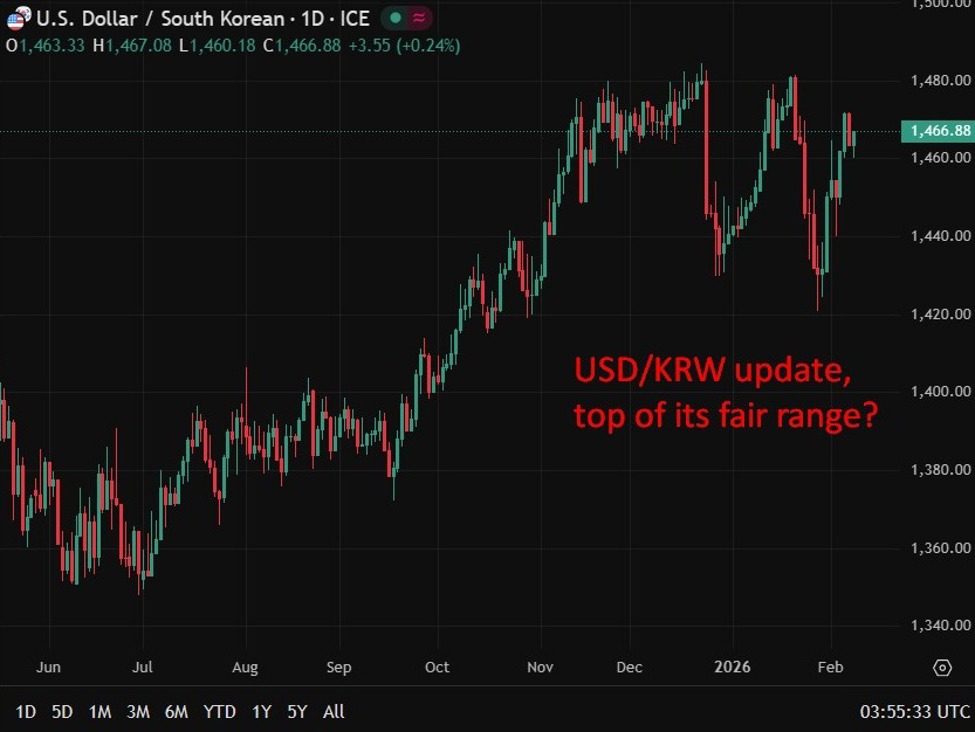
BoK governor contender Lee says it’s too early to talk tightening, urging tougher housing taxes while calling USD/KRW’s current range broadly appropriate.
Summary:
-
Former Bank of Korea board member Lee Seung-heon, a leading governor contender, says it’s too early to signal policy tightening
-
He argues Korea should lean more on tougher property ownership taxes to cool housing-driven inflation risks
-
Lee says USD/KRW 1,400–1,470 looks like a reasonable “natural range” for now
-
BoK has held rates at 2.50% after multiple cuts, with policymakers now emphasising financial stability
-
Implication: macroprudential/fiscal housing tools may do more of the heavy lifting than rate hikes in the near term
A leading contender to become South Korea’s next central bank governor is pushing back on the idea that the Bank of Korea should pivot quickly toward tighter monetary policy, arguing it is premature to signal rate increases even as financial markets price less easing and housing concerns simmer.
Lee Seung-heon, a former Bank of Korea board member who previously served as a senior deputy governor, said growth remains soft enough that officials should avoid rushing toward a tightening narrative. Lee suggested markets have moved “too quickly” in repricing the front end of the curve, pointing to the recent jump in three-year government bond yields as investors pared expectations for further policy easing.
Instead, Lee’s preferred inflation-fighting lever sits outside monetary policy: housing. He argued that stabilising the property market will be difficult unless the cost of owning homes rises, explicitly backing higher property ownership taxes as a way to curb speculation, damp price momentum and reduce the risk that shelter costs re-ignite inflation. The message aligns with the broader policy direction in Seoul, where the government has been sharpening rhetoric on housing speculation and signalling tougher real-estate settings.
On the currency, Lee struck a notably relaxed tone. With the won trading around the mid-1,460s per dollar, he said 1,400 to 1,470 looks like a fair range for now, implying the exchange rate is broadly consistent with fundamentals. He added that moves weaker than roughly 1,450 would reflect external anxiety more than domestic conditions, and while the won could briefly breach 1,500, he doubts such levels would be sustainable.
For markets, the implication is twofold. First, Lee’s stance reinforces an “on hold” BoK bias rather than a near-term pivot back to hikes: policy may remain neutral at 2.50% while officials monitor FX volatility and financial stability risks. Second, his emphasis on property taxes points to a policy mix where fiscal and regulatory tools are increasingly used to contain housing-driven inflation and leverage, potentially reducing the need for rate tightening, though at the cost of greater political and implementation risk.
The won angle is also important: if officials judge current levels as “appropriate,” there may be less urgency for aggressive currency-defence measures unless volatility becomes disorderly or externally driven stress intensifies.


Leave a Reply