

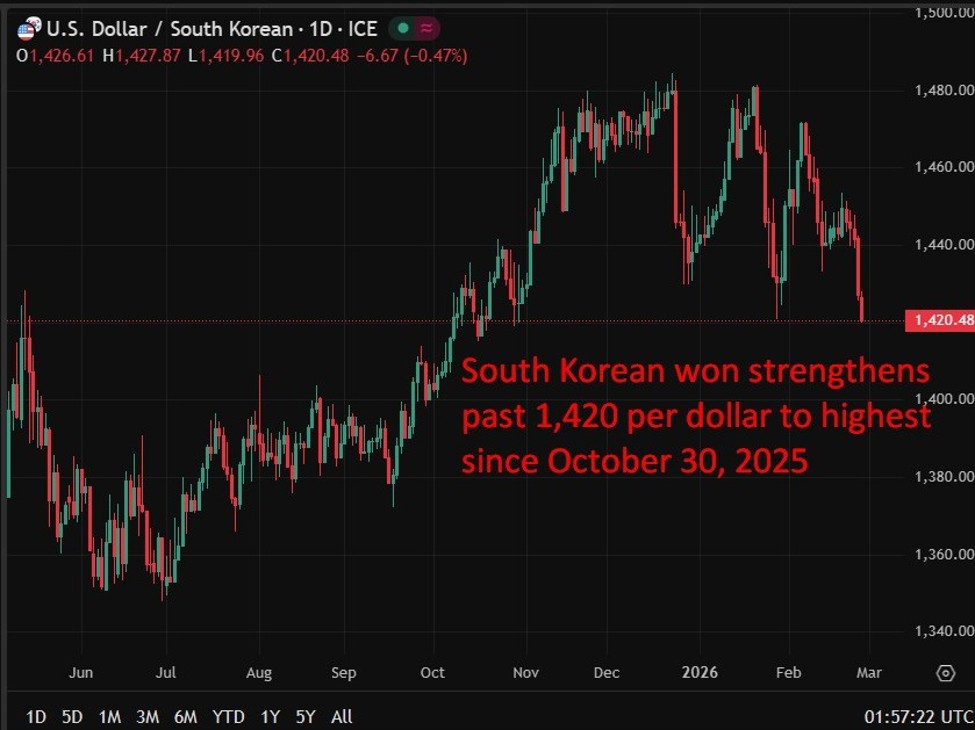
BOK’s new dot plot reinforces a 2.50% hold bias, with only a small minority pricing a cut.
Summary:
-
More from the Bank of Korea’s Feb 26 decision: the hold at 2.50% was unanimous.
-
The new six-month “dot plot” shows the board’s centre of gravity is a prolonged hold.
-
16 of 21 dots sit at 2.50%, pointing to a strong bias to keep policy steady.
-
A minority skew slightly dovish: 4 dots at 2.25% imply some scope for one cut.
-
Only 1 dot at 2.75% signals limited appetite for a hike in the next six months.
-
BOK says growth momentum remains favourable, with strong chip exports underpinning activity.
-
Policy stance: support the recovery while closely monitoring inflation and financial stability.
-
Key risks flagged: geopolitics, tariffs, and housing/household debt/FX volatility.
-
On domestic risks: household loans rose only slightly and Seoul housing price gains have slowed.
More details from the Bank of Korea’s policy decision earlier confirm a steady-as-she-goes stance — and the new “dot plot” framework leans heavily toward an extended pause.
The BOK held its benchmark rate at 2.50% as expected, and it later confirmed the decision was unanimous, underscoring a strong consensus that policy is appropriately set for now. Alongside the decision, the central bank published the first iteration of its expanded forward-guidance scheme, providing a clearer window into policymakers’ near-term rate thinking.
The six-month dot plot, based on 21 projections (three per board member), shows the distribution clustered tightly around the current setting. Sixteen of the 21 projections sit at 2.50%, signalling that most policymakers see the base rate unchanged through the next half year. A smaller dovish minority is visible: four projections point to 2.25%, indicating some members see a possible cut scenario if conditions evolve in that direction. By contrast, only one projection sits at 2.75%, suggesting limited conviction behind near-term tightening.
On the macro backdrop, the BOK said growth momentum should remain favourable, pointing to strong semiconductor exports as a key support. At the same time, it emphasised it will make policy decisions in a way that supports the economic recovery while closely monitoring changes in domestic and external policy conditions and their knock-on effects for inflation and financial stability.
Risk language stayed focused on the usual pressure points. The BOK flagged geopolitical risks and tariffs externally, and reiterated the need for caution on housing prices, household debt and exchange-rate volatility domestically. It added that household loans increased only slightly and that housing price gains around Seoul have slowed, suggesting some moderation — but not enough to declare the financial-stability story resolved.


Leave a Reply