

At a glance;
-
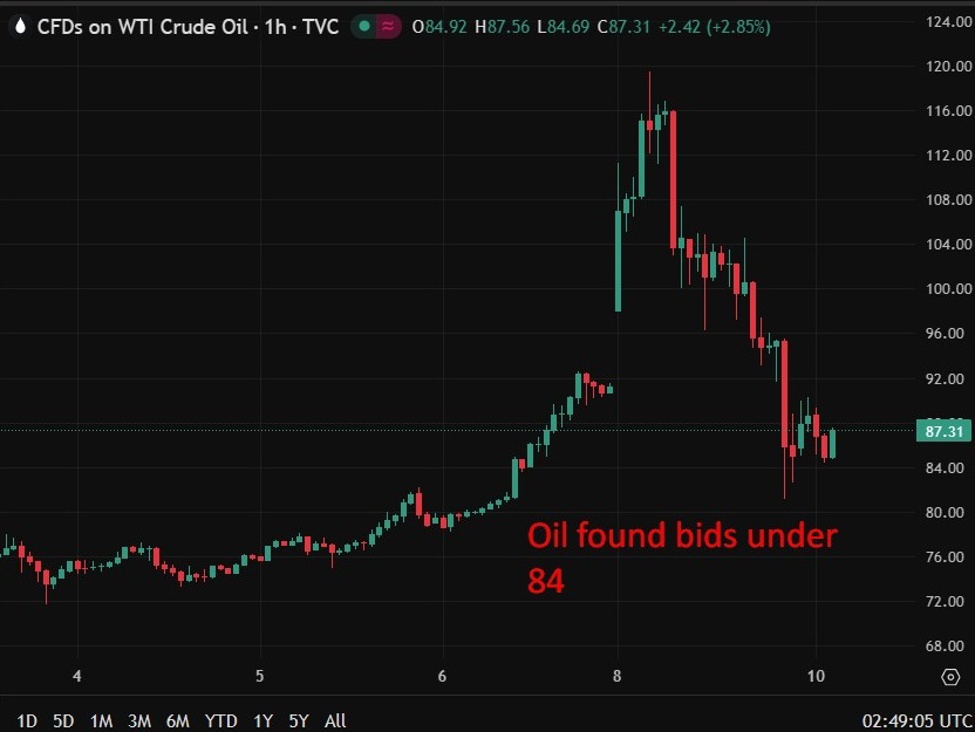
Oil markets remained extremely volatile after Monday’s historic intraday swing in WTI crude.
-
Donald Trump delivered mixed messages on the Iran war, alternating between suggesting the campaign is largely complete and warning it will continue until victory is secured.
-
Trump also warned Iran would face much heavier bombing if it disrupts oil flows from the region.
-
Iran’s Revolutionary Guards responded defiantly, saying Tehran will determine when the war ends and threatening to halt regional oil exports if attacks continue.
-
Oil prices eased slightly in Asia ahead of G7 energy ministers’ talks on a possible coordinated release of emergency reserves.
-
Japan’s GDP was revised sharply higher for Q4 2025, supported by strong capital expenditure, while FX markets were mostly quiet with the yen firmer and gold higher.
Oil markets continued to swing after Monday’s dramatic surge and reversal in crude prices. Front-month WTI recorded the largest intraday trading range on record outside of the extreme volatility seen during the COVID period.
The turbulence has been driven primarily by the escalating war involving Iran and uncertainty surrounding its potential impact on energy supplies.
Comments from U.S. President Donald Trump added to the confusion. On Monday he suggested the military campaign was already largely accomplished and progressing faster than expected, describing the operation as close to completion. At the same time he stressed the conflict was not yet finished, saying the United States had not achieved enough and that the war would continue until a decisive victory was secured.
The messaging was contradictory, with Trump describing the situation as both nearing completion and only the beginning of a broader effort. He also warned that the United States would escalate its military response significantly if Iran attempted to disrupt oil shipments from the region.
Iran signalled it intends to resist that pressure. The country’s Islamic Revolutionary Guard Corps responded to Trump’s remarks by stating that Tehran would determine when the conflict ends. It also warned that if U.S. and Israeli attacks continue, Iran would prevent any oil exports from leaving the region.
Oil prices have eased somewhat in Tuesday’s Asian session as traders look ahead to discussions among G7 energy ministers later today. The group is expected to consider a coordinated release of strategic petroleum reserves to stabilise markets, with reports suggesting a joint release of roughly 300–400 million barrels could be under discussion.
Away from geopolitics, Japan released revised economic data showing stronger-than-expected growth at the end of last year. Fourth-quarter GDP was upgraded sharply to 1.3% annualised from an initial estimate of 0.2%, largely reflecting a surge in business investment. Private consumption was also revised higher, though more recent data showed household spending falling in January.
In currency markets, the yen gained modestly while broader moves across major FX pairs remained relatively subdued. The U.S. dollar edged slightly higher overall, while gold prices rallied as investors maintained demand for safe-haven assets amid the geopolitical uncertainty.

Leave a Reply