

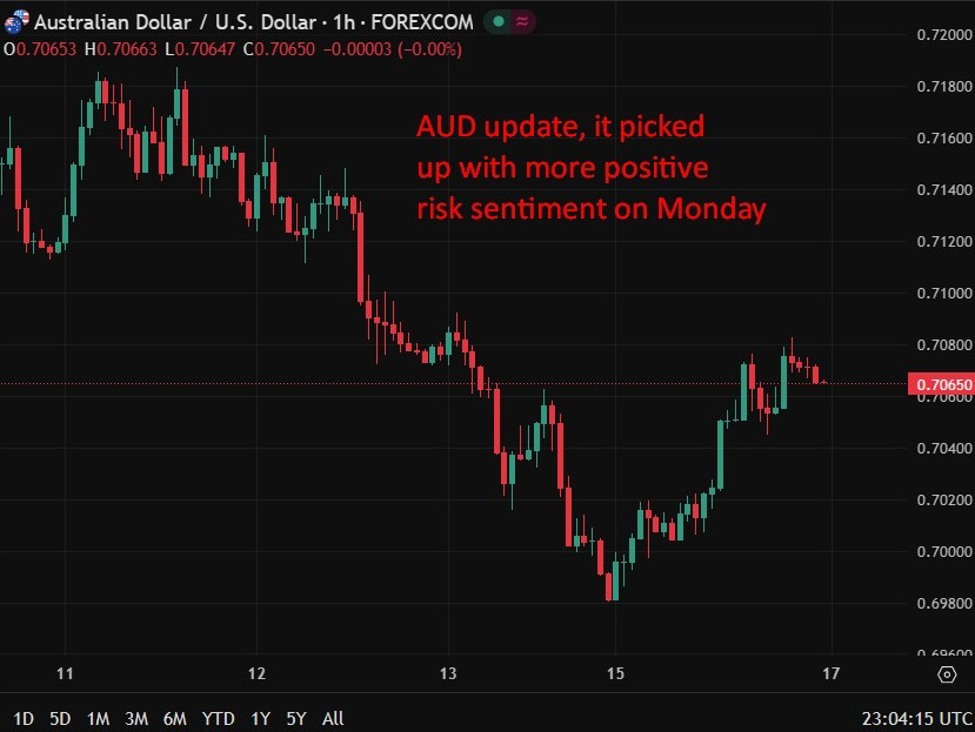
An Reserve Bank of Australia rate hike today is widely expected, but its not unanimous by any means. I’ve seen good arguments from those forecasting a ‘hawkish hold’. I expect the Bank will hike though:
Statement due at 0330 GMT / 2330 US Eastern time, with Reserve Bank of Australia Governor Bullock speaking an hour later.
MUFG expects the RBA to hike rates at its meeting, with markets pricing nearly three increases in 2026.
Summary:
-
MUFG Research expects the Reserve Bank of Australia to raise interest rates at its March policy meeting, potentially making it the first G10 central bank to respond to the recent global energy price shock.
-
Financial markets are currently pricing around 17+ basis points of tightening this week, with expectations for close to three rate increases in total by the end of the year.
-
The bank says a rate hike combined with clear forward guidance would be needed to validate the recent hawkish shift in market pricing.
-
The Australian dollar has been among the strongest G10 currencies this year, supported by rising domestic yields and stronger commodity prices.
-
MUFG warns the main risk to the currency’s bullish trend would be a deeper oil-driven global slowdown and broader risk-asset selloff.
MUFG Research expects the Reserve Bank of Australia to begin tightening policy again at its March meeting, positioning it as the first major developed-market central bank to respond directly to the recent surge in global energy prices.
According to the bank’s preview of the upcoming policy decision, financial markets have already shifted expectations sharply in recent weeks. Interest rate derivatives now imply roughly 17 basis points of tightening at the March meeting and close to three increases in the cash rate by the end of the year.
This repricing reflects concerns that the sharp rise in global energy costs could push inflation higher again and delay the disinflation process that central banks had been expecting earlier in the year.
MUFG believes the Reserve Bank would need to deliver both a rate increase and a strong signal that further tightening remains likely if it wants to validate the recent hawkish shift in market expectations. Without a clear policy message pointing toward additional rate rises, markets could scale back their tightening bets.
Australia’s currency has already responded positively to the shift in the interest-rate outlook. The Australian dollar has been among the best-performing currencies in the Group of Ten so far this year, supported by rising domestic bond yields and the renewed strength in commodity prices following the surge in energy markets.
Australia’s status as a major exporter of commodities such as iron ore, coal and liquefied natural gas has also helped underpin the currency’s resilience during the recent bout of geopolitical tensions and energy market volatility.
However, MUFG warns that the outlook for the Australian dollar remains sensitive to global macroeconomic conditions.
While higher commodity prices and rising yields have supported the currency in recent months, a further escalation in the oil price shock could ultimately prove negative if it leads to a sharper slowdown in global growth.
A more severe energy-driven downturn could weigh heavily on risk assets and global demand, potentially reversing the positive momentum that has helped lift the Australian dollar this year.
rba cash rate cycle


Leave a Reply