
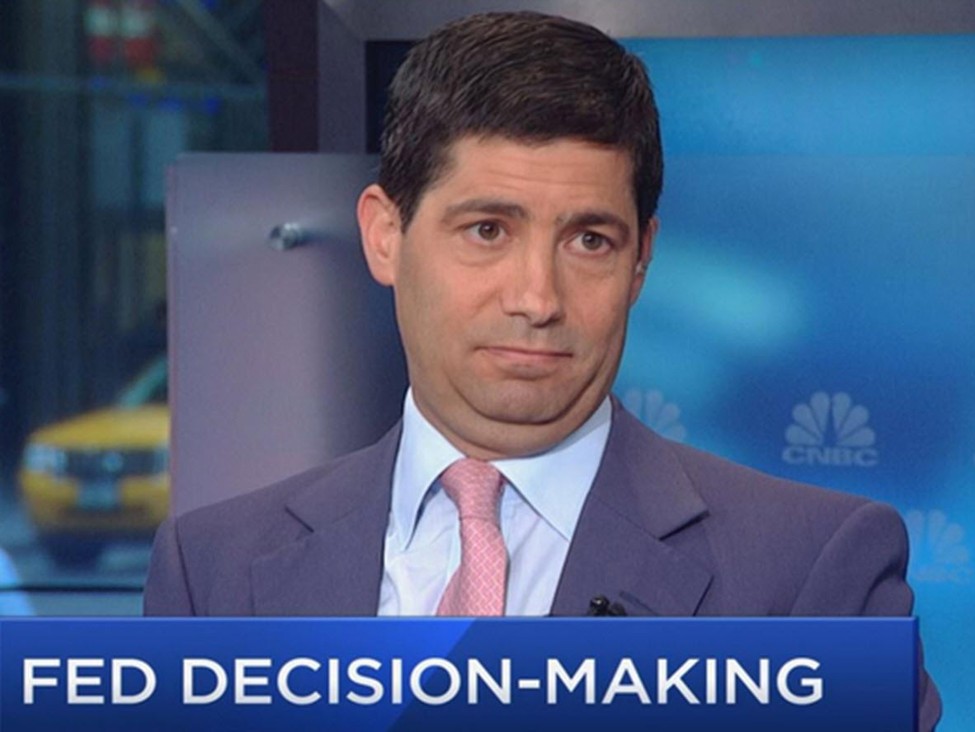
Warsh’s potential Fed leadership comes at a uniquely difficult moment, with rising inflation, political pressure, and transition uncertainty complicating the policy outlook.
Info comes via the Wall Street Journal, gated.
Summary:
- Kevin Warsh faces unusually complex Fed leadership transition
- Confirmation stalled amid political dispute over Powell probe
- Oil shock and rising inflation complicate policy outlook
- Markets now pricing hikes over cuts despite prior dovish expectations
- Trump pressure for lower rates adds political tension
- Warsh previously signalled sharp break from Powell-era policy
- Risk of perceived political influence on Fed decisions rising
- Transition uncertainty grows as Powell may remain in role
Kevin Warsh’s potential transition to Federal Reserve chair is shaping up to be one of the most complex and politically charged handovers in decades, as rising inflation, an energy shock, and a stalled confirmation process collide.
Warsh, who had previously signalled support for lower interest rates, now faces a dramatically altered economic backdrop. Inflation pressures were already building before the escalation in the Middle East drove oil prices higher, and markets have since shifted expectations toward the possibility of further rate increases rather than cuts in the near term.
At the same time, his confirmation remains uncertain. A political standoff linked to a Justice Department investigation involving current Fed Chair Jerome Powell has delayed proceedings, leaving open the possibility that Powell could remain in the role even after his term expires. This raises the prospect of an overlapping or delayed leadership transition, adding to institutional uncertainty.
The situation is further complicated by political pressure from President Donald Trump, who has made clear that he expects lower interest rates. Analysts say this creates a difficult balancing act for Warsh, who must navigate between presidential expectations, a Federal Open Market Committee that has grown more cautious on rate cuts, and a macro environment increasingly shaped by inflation risks.
Unlike previous Fed transitions, Warsh has publicly criticised the policy direction under Powell, calling for a more fundamental shift in approach. Historically, incoming Fed chairs have emphasised continuity to reassure markets, even when planning longer-term changes. Warsh’s more confrontational stance has raised questions about how smoothly the transition can be managed.
The current macro backdrop adds to the challenge. Central banks typically look through oil shocks, assuming that higher inflation is offset by weaker growth. However, after several years of above-target inflation, policymakers may be less confident that price pressures will quickly fade, increasing the risk that inflation expectations become entrenched.
This leaves the Fed facing a familiar dilemma: whether to prioritise inflation control or support growth. For Warsh, the challenge is heightened by the political context, with any policy easing likely to be scrutinised for signs of political influence.
While some economists argue that the broader economic environment remains stable, others note that the combination of geopolitical risk, inflation uncertainty, and leadership ambiguity creates a uniquely difficult starting point for any incoming Fed chair.
What happens next? The immediate focus is on the timing and outcome of Warsh’s confirmation.
If the process remains stalled, Powell could continue to lead the Fed beyond his term expiry, prolonging uncertainty around policy direction. This would likely reinforce a “wait-and-see” stance in markets, with traders focusing more on incoming data than leadership expectations.
If Warsh is confirmed, attention will shift quickly to whether his policy stance aligns with current market conditions. While he had previously leaned toward rate cuts, the evolving inflation outlook, particularly if energy prices remain elevated, may force a more cautious or even hawkish approach.
Markets will also be watching for signs of institutional cohesion. Any perception of division within the Federal Open Market Committee, or between the Fed and the White House, could increase volatility across rates, FX, and risk assets.
The biggest macro variable remains inflation. If oil-driven price pressures prove temporary, the Fed may still be able to pivot toward easing later. However, if inflation proves persistent, policymakers could be forced to prioritise price stability, even at the cost of weaker growth.
In that scenario, Warsh could find himself taking a very different policy path than the one he initially signalled, highlighting how rapidly the economic landscape has shifted.


Leave a Reply