

Westpac sees Australia CPI steady but flags energy-driven upside risks.
In brief from their preview.
Summary:
- February CPI seen at 0.1% m/m, 3.8% y/y (unchanged)
- Trimmed mean expected 0.3% m/m, 3.4% y/y
- Inflation momentum steady but still above target band
- February data pre-dates Middle East energy shock
- Fuel prices fell in February, masking underlying pressures
- Energy shock could lift CPI to ~4.6% y/y by June quarter
- Risks skewed to upside if conflict persists
Westpac expects Australia’s February CPI to show inflation holding steady, but warns that emerging energy shocks are likely to push inflation higher in the months ahead, complicating the outlook for the Reserve Bank of Australia.
The bank forecasts a modest 0.1% monthly rise in CPI for February, leaving the annual rate unchanged at 3.8% for a third consecutive month. Underlying inflation is also expected to remain sticky, with the trimmed mean seen rising 0.3% on the month and holding at 3.4% year-on-year.
While this points to some stability in inflation, the details suggest price pressures remain persistent. Housing costs, particularly rents and electricity, continue to rise, while categories such as education and clothing are also contributing to upward pressure. At the same time, falling fuel prices and seasonal declines in travel costs are expected to offset some of these gains, keeping headline inflation contained in the near term.
Crucially, the February data does not yet reflect the impact of the recent escalation in the Middle East. The surge in oil prices and disruption to shipping through the Strait of Hormuz occurred too late to feed into the February CPI print. As a result, the current data is likely to understate the inflation pressures building in the pipeline.
Looking ahead, Westpac expects energy markets to play a dominant role in shaping the inflation trajectory. Under its baseline scenario—assuming a temporary disruption to Gulf shipping—headline inflation is projected to rise to around 4.6% year-on-year in the June quarter before easing later in the year. Higher fuel, transport and input costs are expected to flow through to consumer prices, with some spillover into food and services.
While the direct impact on underlying inflation is expected to be more limited, there are growing risks of second-round effects. If higher energy prices begin to influence inflation expectations or wage-setting behaviour, inflation could prove more persistent than currently anticipated.
Overall, the outlook suggests inflation is stable for now but facing renewed upside risks, leaving policymakers with a more complex path as global developments increasingly shape the domestic inflation profile.
***************
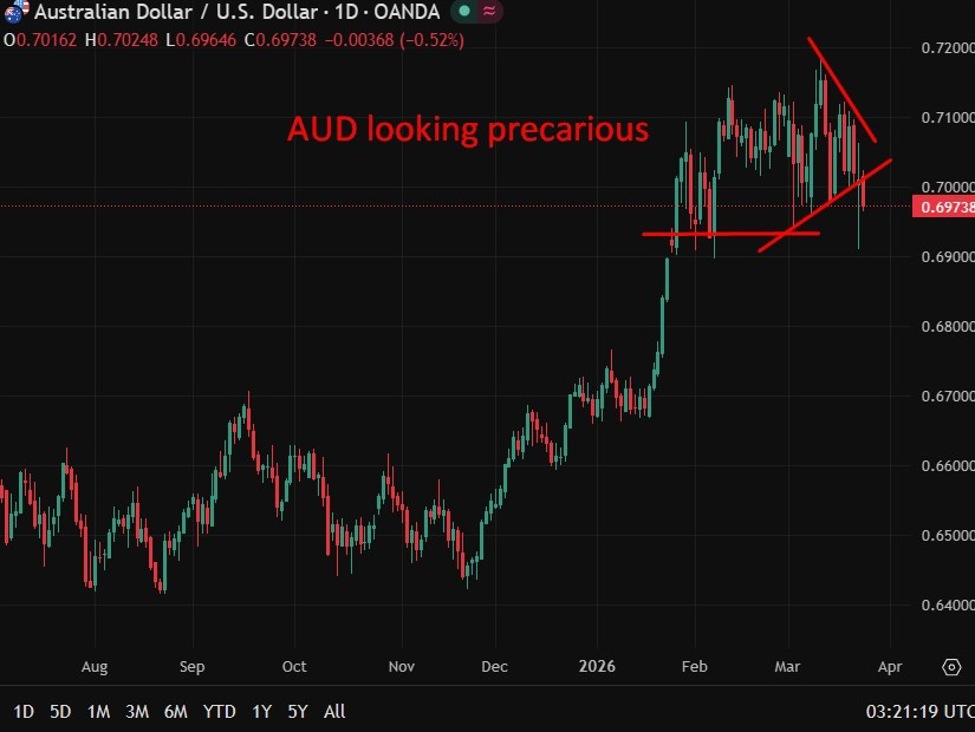
For the Australian dollar, the February CPI print is unlikely to be a major catalyst on its own, given expectations for a steady 3.8% annual pace and the known lag in energy impacts. Markets are more likely to look through this release and focus on the forward trajectory for inflation, particularly as rising oil prices begin to feed into headline and core measures in coming months.
A stronger-than-expected print, especially in the trimmed mean, would reinforce expectations that the RBA may need to tighten further, providing near-term support for the AUD. Conversely, any downside surprise could weigh modestly on the currency, though such moves may be limited given the market’s awareness that energy-driven inflation pressures are still ahead.
More broadly, the AUD outlook will increasingly hinge on how quickly energy costs translate into sustained inflation and whether this shifts the RBA’s policy path. However, global risk sentiment tied to the Middle East conflict remains a key offset, meaning AUD direction may ultimately be driven as much by geopolitical developments as by domestic inflation data.




Leave a Reply