

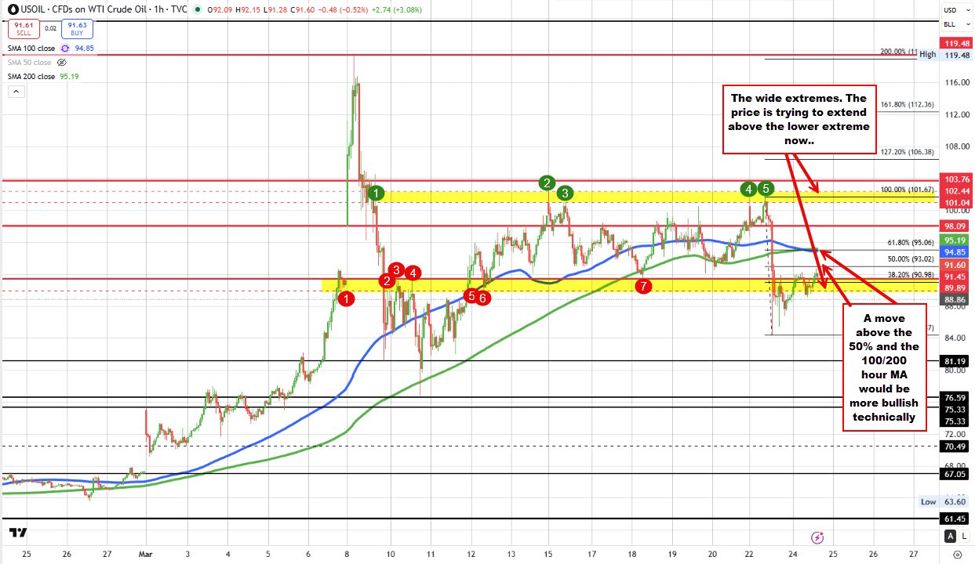
Crude oil futures saw a dramatic reversal yesterday, triggered by President Trump’s Truth Social comments, and the price action reflected just how fragile sentiment currently is in this market. The contract traded in an exceptionally wide range—from a high near $101.67 to a low around $84.37—a nearly $17 swing that underscores the heightened volatility tied to geopolitical headlines.
From a technical perspective, that range defines the battlefield. The 50% midpoint at $93.02 becomes a key barometer for buyers and sellers. As I often say, the midpoint is not just a number—it’s a bias-defining level. If the market can reclaim and hold above it, the buyers start to regain control. If not, the sellers keep the upper hand.
So far today, the rebound has stalled. The high price has reached $92.68, just shy of that midpoint. That failure to break above keeps the sellers leaning. The market had its shot—and at least for now—missed.
For buyers to take more control, they need to do more than just poke above $93.02. They need to get above and stay above that level, and then build momentum toward the next targets: the 100-hour and 200-hour moving averages, which currently come in near the $95 area (±$0.20). Those moving averages are not random—they are trend-defining and risk-defining tools that traders around the world are watching. A move above them would shift the short-term bias and likely trigger additional upside momentum.
On the downside, the focus shifts to a well-defined swing area between $89.89 and $91.45. This zone has acted as a magnet for price over multiple sessions going back to March 7–8, with both swing highs and lows forming there. That history gives it weight—it’s a borderline level.
Earlier today, the price dipped below that zone, reaching an intraday low of $88.50, but sellers could not extend the move. That inability to sustain downside momentum led to a rotation back higher—an early sign that sellers, while still in control, are not dominating.
Putting it all together:
- Below $93.02 (50% midpoint) → sellers remain in control
- Below $95 (100/200-hour MAs) → downside bias stays intact
- Holding above $89.89 → gives dip buyers a defined risk level
This is where the trade becomes tactical. If the price can stay above $89.89, dip buyers—especially those leaning on continued geopolitical tension in the Middle East—have a clear place to define and limit risk. That’s the key: know where you’re wrong before you get in.
However, until the market can reclaim the midpoint and push above the moving averages, rallies risk being corrective rather than the start of a new trend higher.
What next?
If buyers can take the price above $93.02 and hold it, the focus shifts toward $95 and beyond. If not, and the price rotates back below $89.89, the sellers will look to reassert control and push back toward the lows.
In the video, I walk through these levels step-by-step and show exactly why traders are reacting to them—and how they define risk in a market that is being driven as much by headlines as by charts.




Leave a Reply