

Summary:
- US forces sank two IRGC vessels laying mines in the Strait of Hormuz and struck a surface-to-air missile site at Bandar Abbas; Iran launched anti-ship cruise missiles at US Navy assets in response; CENTCOM called the actions defensive and said the ceasefire remains intact
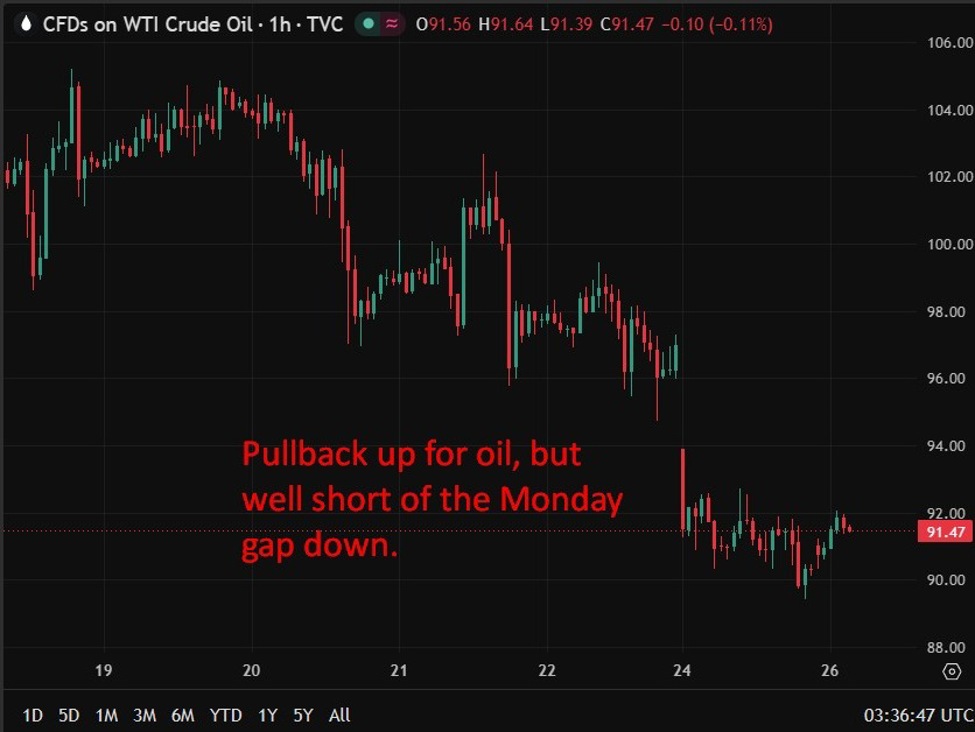
- Oil futures partially recovered from Monday’s near-7% drop overnight, though gains were capped by the resumed hostilities; a source cited Qatari mediation producing an understanding on Iran’s frozen financial assets, with a deal announcement possible as soon as Tuesday
- Trump softened his position on Iran’s enriched uranium, indicating material could be destroyed in place or transferred to a third country under IAEA supervision rather than shipped to the US, removing a significant barrier to agreement
- Rubio said deal language could be finalised within a few days; Pakistan’s army chief Asim Munir was reported heading to Doha, positioning a key mediator at the table for what looks like a final round
- Gold and silver fell in Asian trade
- Markets read the simultaneous shooting and negotiating as evidence of a deal in its closing stages rather than a conflict at risk of widening
- The USD firmed modestly and equities were under mild pressure
- BOJ Deputy Governor Himino reaffirmed the rate hike path in Diet testimony, flagging Middle East developments as the key variable on timing; Finance Minister Katayama pledged timely action to cushion household impact from energy costs
- A magnitude 6.9 earthquake struck Chile’s Antofagasta copper mining region on Monday; major miners reported limited damage and no fatalities, though some operations were temporarily disrupted
- The PBoC set the USD/CNY mid-point at 6.8288, stronger than the 6.7822 expected and the firmest fix for the yuan since February 2023, signalling continued official support for the currency
- Sri Lanka raised its overnight policy rate by 100 basis points to 8.75%, citing surging oil prices, April inflation of 5.4% and rupee depreciation pressure linked to the Middle East conflict
The dominant theme across the Asia session was a conflict that refused to stay contained and a deal that refused to fall apart. US forces sank two IRGC mine-laying vessels (speedboats) in the Strait of Hormuz and struck a missile site at Bandar Abbas after Iran activated air defences and launched anti-ship cruise missiles toward US Navy assets in the Sea of Oman and the strait itself. Four Iranian sailors were reported killed. CENTCOM described every action as defensive and insisted the ceasefire framework remained operative. Both characterisations strained credulity in isolation; together, they captured the strange discipline of a conflict being managed toward a conclusion neither side wants to abandon.
Oil futures clawed back some of Monday’s near-7% decline but could not sustain a full recovery. The overnight bid was supported by a source report that Qatari mediation had produced a mutual understanding on Iran’s frozen financial assets, and that a formal announcement of a US-Iran agreement could come as early as Tuesday. That is an aggressive timeline, and Rubio’s own framing, focused on days of language negotiations rather than hours to a signing, suggested some caution was warranted. Even so, the architecture of a deal is visibly taking shape.
Another significant development of the session was Trump’s public retreat on the nuclear material question. Having previously insisted Iran’s enriched uranium be shipped to the United States, Trump indicated on Truth Social that destruction in place under IAEA supervision, or transfer to a third country, would be acceptable. Iran has floated China as a possible destination. The two positions are now close enough that negotiators are arguing over geography rather than principle. Pakistan’s Asim Munir moving to Doha for what appears to be a final mediation round adds further weight to the sense that the endgame is being played out in real time.
Gold and silver fell as Asian markets digested all of this. The USD firmed modestly and equities were under light pressure, reflecting residual uncertainty rather than any conviction that the situation is deteriorating.
The combination of active combat and active diplomacy reads as proximity to a finish line, not distance from one.
Away from Hormuz, the session carried its own macro freight. BOJ Deputy Governor Himino held the rate hike line in Diet testimony, with the Middle East flagged as the key timing variable. Finance Minister Katayama signalled fiscal readiness to protect households from energy costs, with consumption tax speculation circulating in the background but firmly un-confirmed by Deputy Chief Cabinet Secretary Ozaki. The PBoC fixed the yuan at its strongest level since February 2023, a signal of official comfort with currency appreciation at a moment of global uncertainty. And Sri Lanka delivered a 100 basis point rate hike to 8.75%, the starkest illustration yet of how the Hormuz closure is being transmitted into emerging market policy rates far from the strait itself. A magnitude 6.9 earthquake in Chile’s Antofagasta copper region rattled the mining sector briefly; damage was limited and no fatalities were reported.
The session closes with a deal that feels closer than any point in three months, a ceasefire that is being tested daily, and markets that have largely decided to believe the diplomats over the generals. Whether that judgment holds through Tuesday will depend on what comes out of Doha.

Leave a Reply