

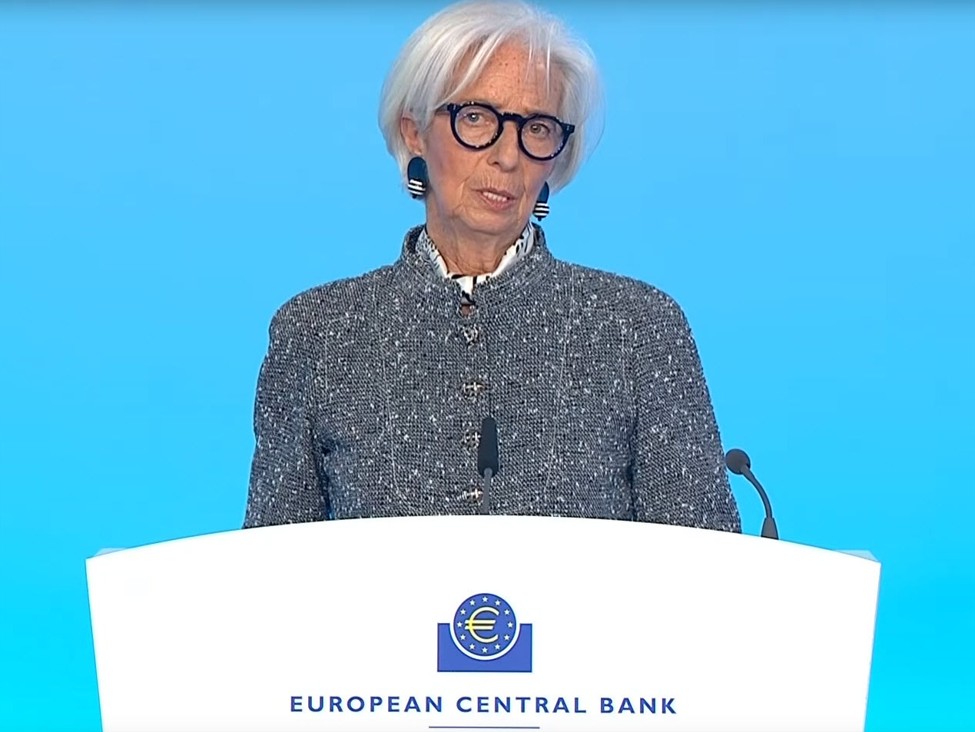
ECB President Christine Lagarde earlier highlighted ECB March staff projections and the baseline showed growth revised down to 0.9% for 2026, headline inflation revised up to 2.6% on the back of the energy shock. But the baseline isn’t where the most important information lies.
The alternative scenarios were just released and offer some insight on tail risks and, crucially, how they believe large energy shocks transmit through the economy.
The adverse scenario assumes 40% of Hormuz oil and LNG flows are disrupted, pushing brent crude to $119 (which it touched today) and TTF gas to nearly €87/MWh in Q2. Inflation reaches 3.5% in 2026 before fading. The severe scenario is considerably more challenging: 60% of Hormuz flows disrupted with infrastructure damage, oil at $145 and gas at €106. Under that path, headline inflation reaches 4.4% in 2026 and remains at 4.8% through 2027. That represents an entirely different policy environment and a big problem.
What stands out is the ECB’s explicit acknowledgment of non-linearities in transmission. Staff are signalling that their standard models underestimate how large energy shocks propagate across the broader economy — a lesson drawn directly from the 2021-22 experience. The scenario models have been recalibrated to sit between normal elasticities and what was actually observed during the post-Ukraine inflation surge. That is a meaningful signal about how the Governing Council is approaching risk assessment and tilts hawkishly.
The critical caveat is that none of these scenarios incorporate a monetary policy response. The ECB is effectively presenting the unmitigated impact. In the severe case, core inflation reaches 3.9% in 2027. It is difficult to imagine any scenario in which the Governing Council remains passive if those dynamics begin to materialize but by hiking rates, they would crush growth.
The asymmetry is worth noting. The baseline keeps the ECB on a gradual normalization path. The severe scenario would force a considerably more hawkish stance than markets currently anticipate. Option-implied densities on energy prices remain heavily skewed to the upside in the near term, suggesting the market perceives the risk distribution similarly.
I tend to think of all of these scenarios as useful but not a roadmap for what the ECB will do because so much of what happens in the economy is dynamic and no one can predict the details of this war and the inherent uncertainty.
The euro is up 66 pips to 1.1516 today on broad USD weakness.
EURUSD 10 mins


Leave a Reply