
Quick Summary:
Success in Forex isn’t about predicting the win; it’s about defining where you are wrong. This guide covers the 3-step risk process: Defining (Technical levels), Limiting (Position sizing/proximity), and Accepting (Mental edge).
A Text That Boosted My Ego (And Proved My Point)
A few years ago, at a social gathering, I met someone through a mutual friend who traded Forex. Naturally, we got to talking shop. During the conversation, I hammered home a point I make to anyone who will listen: risk management is the most important aspect of trading.
I didn’t hear from her for a long time. But this week, I received a surprise text that gave my ego a bit of a boost. She wrote:
“I wanted to acknowledge something you said to me… You told me that risk management was the most important aspect of trading. At the time, I probably didn’t even know what that meant. But I do now, and I have finally come to understand exactly what you were trying to tell me!”
In my reply, I told her:
“We—as a people—tend to prefer focusing on the reward in trading (and in life). It’s more positive, after all. But if you focus on the risk, you know exactly where you are wrong. If you can live with that, and you aren’t ‘risked out’ (stopped out), you still get your rewards. Targeting where you are going is just the next step.”
Cracking the “Trader Code”
If you follow my videos or my posts, you know I’m a stickler for defining risk. I might write something like this in a market update:
“…The bias for the EURUSD is negative following the break of those two moving averages and remains so below the rising trend line. Traders would now NOT want to see the price moving back above those moving averages—at least in the short term. That would disappoint the sellers on the break to the downside and likely lead to more upside momentum.”
To a casual observer, that’s just technical analysis. But in “trader code,” those words actually mean: “This is your risk-defining level RIGHT HERE. This is your stop-loss area.”
Traders need to know where they are wrong. They need to know the exact point where a negative bias turns positive, or where a positive bias turns sour. Technicals define those action areas.
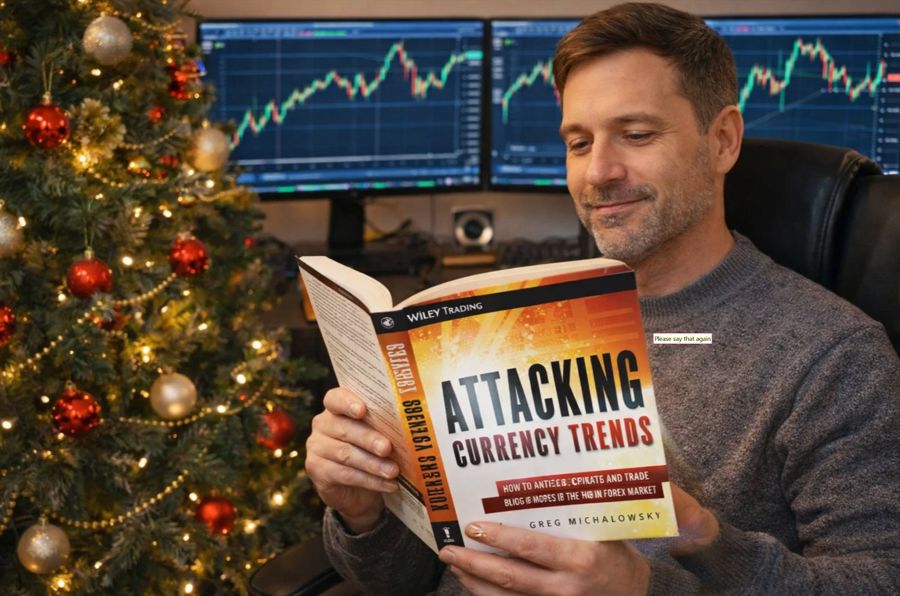
One of the core messages in my book, Attacking Currency Trends, is that successful trading starts with risk, not reward. Before you ever think about profit targets, you must be clear on what the risk is, how it is limited, and whether it is acceptable. This framework creates the discipline and emotional control needed in volatile FX markets where fear often drives bad decisions.
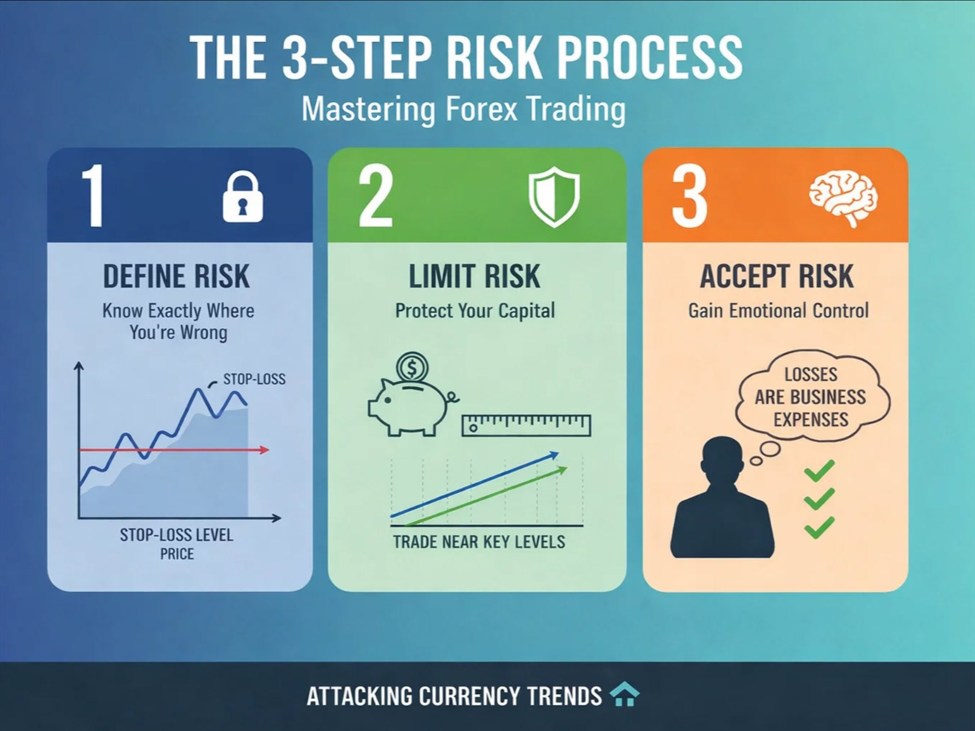
The 3-Step Risk Process
1. Defining Risk: Know Exactly Where You Are Wrong
Risk must be defined before entering a trade. In Attacking Currency Trends, I define risk technically—it is a specific price level that invalidates your trade idea.
Risk is not a random dollar amount; it is a price level. On investinglive.com, I take the approach that readers want to know what the chart is telling them right now and why. That story always revolves around key technical levels: trend lines, moving averages, swing highs/lows, or Fibonacci retracements.
If price breaches that level, the premise of the trade is wrong—not just in my eyes, but in the eyes of the “market.” By defining risk at entry, you answer the most important question first: Where am I wrong? It takes discipline and humility to accept that defeat, but you need as much conviction in your exit point as you do in your entry.
2. Limiting Risk: The Math of Fear
Once risk is defined, you must strive to limit it. I tell traders: we must take risk to make money, but we should try to limit that risk as much as humanly possible.
-
Logic over Emotion: Stops are placed at technical levels “followed by many,” not where you “feel” like putting them.
-
Proximity is Key: Trading as near to a risk-defining level as possible limits your downside and makes reaching profit objectives easier.
Think about the math: If you risk 20 pips, you only need a 20-pip move to reach a 1:1 reward-to-risk ratio. If you enter 50 pips away from your risk level, you need a massive 100-pip move just to reach a 2:1 target.
Trading near your risk level is the ultimate “fear killer.” If you don’t think fear impacts your trading, think again. Defining and limiting risk are the two mechanical steps that keep fear from driving the bus.
3. Accepting Risk: The Mental Edge
Defining and limiting risk is mechanical. Accepting risk is psychological.
You need to be able to tell yourself: “I have done the work to define my risk. I have limited my monetary exposure. I accept this risk in my core being.” Once you do that, the fear disappears because:
-
The risk is already “paid for” mentally the moment you click ‘buy’ or ‘sell.’
-
There is no “hoping,” bargaining, or second-guessing.
-
Losses are treated as business expenses, not personal failures.
Why This Framework Matters
Trends can only be “attacked” consistently when risk is under control. Traders who skip these steps might win occasionally, but they won’t survive the long game.
-
Defined Risk creates clarity.
-
Limited Risk preserves capital.
-
Accepted Risk frees the mind to execute.
The Bottom Line: When risk is defined, limited, and accepted, you put the probabilities on your side and give yourself the best chance to succeed over time.
Merry Christmas and Happy New Year to all. Peace on Earth. Goodwill to all.





Leave a Reply