

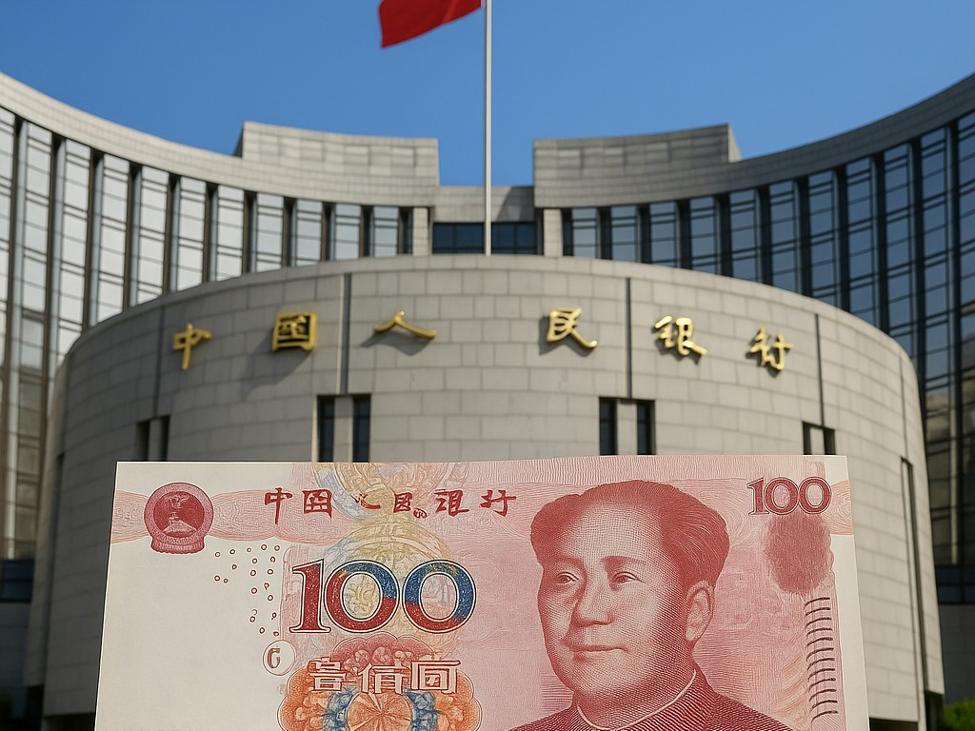
The People’s Bank of China (PBOC), China’s central bank, is responsible for setting the daily midpoint of the yuan (also known as renminbi or RMB). The PBOC follows a managed floating exchange rate system that allows the value of the yuan to fluctuate within a certain range, called a “band,” around a central reference rate, or “midpoint.” It’s currently at +/- 2%.
The close of the previous session was at 7.0412.
The rate at 7.0550 today is the strongest setting for CNY since 30 September, 2024.
Earlier:
The daily fixing of this mid-rate is often interpreted as a policy signal rather than just a technical reference point. A higher-than-expected USD/CNY midpoint is typically read as a sign the PBOC is leaning against CNY appreciation pressure, like today.
—
While you’re here, an ICYMI via Reuters.
China has made a significant, if still incomplete, advance in its push to challenge Western dominance in advanced semiconductor manufacturing, according to sources familiar with a highly classified project in Shenzhen.
In a secure laboratory, a team of Chinese engineers has built a prototype extreme ultraviolet (EUV) lithography machine, the critical technology required to manufacture the most advanced chips used in artificial intelligence, smartphones and military systems. The machine, completed in early 2025 and now undergoing testing, reportedly occupies most of a factory floor and was developed by former engineers from Dutch chip-equipment maker ASML who reverse-engineered the technology, sources said.
EUV lithography sits at the centre of what has become a technological Cold War, as the West has sought to restrict China’s access to the machines through export controls. The systems use extreme ultraviolet light to etch circuits thousands of times thinner than a human hair, enabling the production of the world’s most powerful semiconductors.
While China’s prototype is operational and has successfully generated EUV light, it has not yet produced functional chips, underscoring the technical hurdles that remain. The Chinese government is targeting 2028 for the production of working chips using domestically built EUV tools, though people close to the project say 2030 is a more realistic timeline.
If successful, the effort would mark a major breakthrough in China’s quest for semiconductor self-sufficiency and reduce its reliance on Western technology, with far-reaching implications for global supply chains, geopolitics and the balance of technological power.




Leave a Reply