

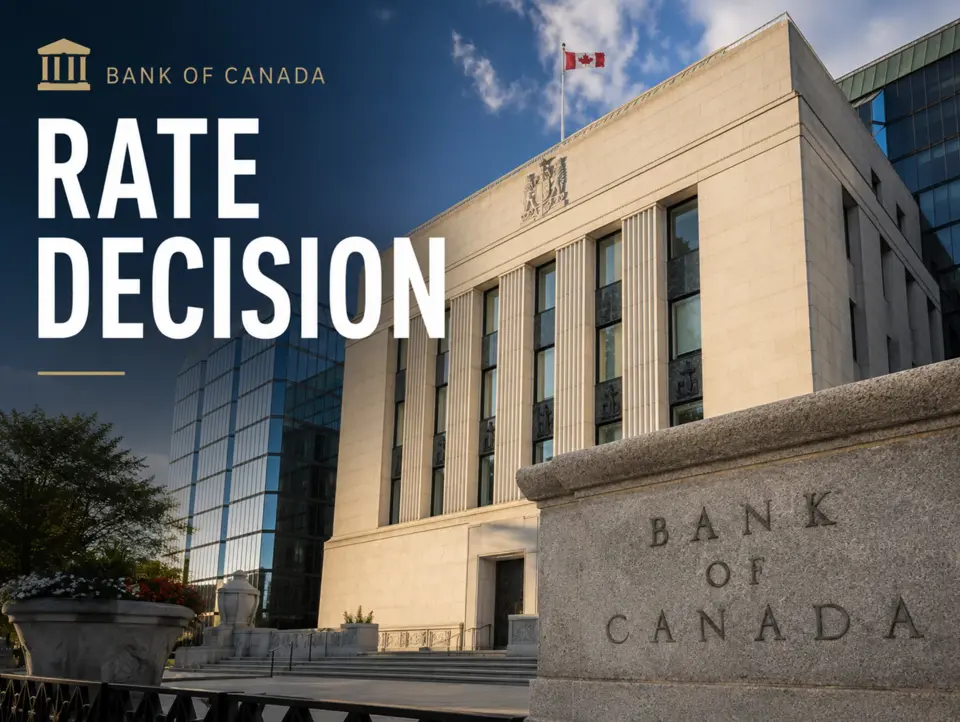
The Bank of Canada kept rates unchanged. Below is the full statement from the central bank. The press conference with Tiff Macklem will begin at 10:30 AM ET.
Full Statement from the BOC:
The Bank of Canada today held its target for the overnight rate at 2.25%, with the Bank Rate at 2.5% and the deposit rate at 2.20%.
The continuing conflict in the Middle East is keeping energy prices high. As well, new US tariffs and Canadian counter-measures have been announced following the breakdown of trade talks between Canada and the United States. Both situations remain fluid.
In the United States, economic growth continues to be solid, driven by consumer spending and AI-related investment. Growth in the euro area was stronger than expected in the second quarter, while China’s economy slowed. Overall, the global economy has shown resilience in the face of geopolitical headwinds, with growth broadly consistent with the July Monetary Policy Report (MPR) projection. With still-high oil prices and elevated margins for refined energy products, inflation in most countries remains high.
Financial conditions have tightened since July. Long-term bond yields have moved up globally, including in Canada. The Canadian dollar has appreciated slightly on US-dollar weakness.
As expected, Canadian economic activity strengthened in the second quarter, with GDP up by 3.3%, following very weak growth in the first quarter. While some of the recent strength reflected temporary factors, the pick-up in activity was broad-based. Consumption showed solid gains. Following several weak quarters, there was some rebound in housing activity. Exports and business investment were up sharply. Labour market conditions have improved in recent months, with the unemployment rate edging down to 6.4% in July. Still, demand for labour remains subdued and indicators point to continued excess supply in the economy.
Overall, recent data reaffirm Governing Council’s view of a broadening recovery in Canada’s economy. However, uncertainty is high and new US tariffs and threats of further action pose risks to the sustainability of the recovery.
CPI inflation has been hovering around 3% in recent months, mainly because of persistently higher gasoline prices. So far, there has been little evidence of higher energy prices spreading to other components of inflation: excluding gasoline, inflation was 2.2% and measures of core inflation remained close to 2% in July. However, with the Middle East conflict still ongoing and little progress reopening the Strait of Hormuz, upside risks to the Bank’s inflation forecast have increased. The longer that high oil prices and elevated refinery margins persist, the greater the risk of spillover to the prices of other goods and services. New US tariffs and Canadian counter-tariffs will also raise costs for some businesses and could feed into consumer prices over time.
With the economy and inflation evolving broadly as forecast in the July MPR, Governing Council agreed to leave the policy rate unchanged. However, the upside risks to inflation have increased, while new tariffs make growth prospects more uncertain. Governing Council will assess the sustainability of the economic rebound and the outlook for inflation, and is prepared to adjust monetary policy as needed. The Bank remains committed to maintaining Canadians’ confidence in price stability through this period of global upheaval.
———————————————
The BOC statement has a modestly hawkish tilt, although it stops short of signalling a rate hike. The key message is that upside inflation risks have increased, while the broadening economic recovery reduces the urgency to cut rates. That combination points toward a prolonged hold, with greater concern about persistent inflation.
The hawkish signals:
- The Bank explicitly says upside risks to its inflation forecast have increased.
- Prolonged high oil prices and elevated refinery margins raise the risk of inflation spreading beyond gasoline.
- US tariffs and Canadian counter-tariffs could push business costs and consumer prices higher.
- The recovery has broadened, with stronger consumption, housing, exports and business investment, alongside improving labour market conditions.
The dovish offsets:
- Core inflation remains close to 2%, with little evidence so far of energy costs spreading to other prices.
- The economy still has excess supply, and labour demand remains subdued.
- New tariffs threaten the sustainability of the recovery, while tighter financial conditions add a headwind.
For policy, the message is more “less room to cut” than “ready to hike.” The Bank retains flexibility to move either way, but its increased emphasis on inflation risks gives this statement a hawkish lean.




Leave a Reply