

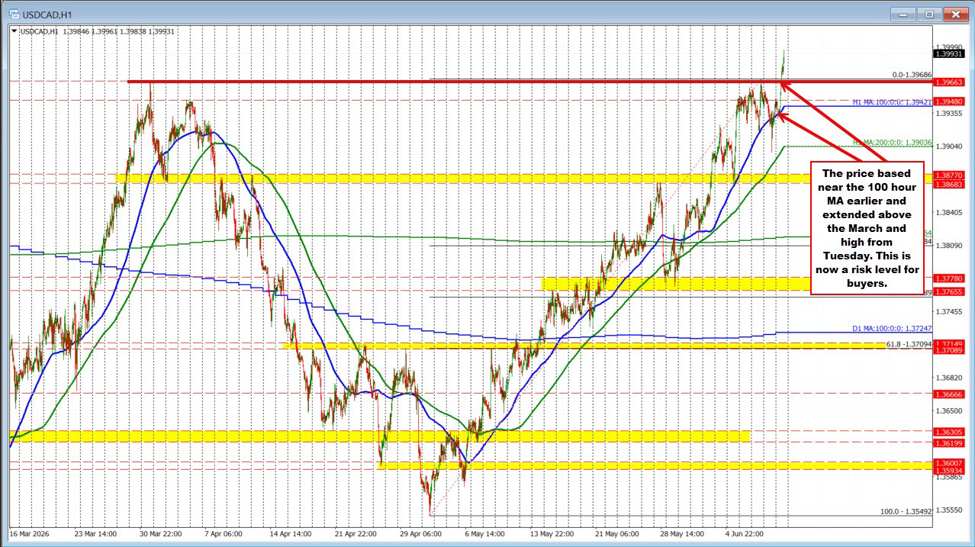
The USDCAD is trading at new session highs near 1.3990, extending to fresh highs for 2026 and reaching its strongest level since early December 2025.
On Tuesday, the pair pushed to 1.39686, briefly breaking above the previous 2026 high from late March at 1.39663. However, buyers were unable to sustain the breakout, triggering a pullback that drove the price below its rising 100-hour moving average. Sellers could not generate enough momentum to reach the 200-hour moving average, and by the close the pair had recovered back above the 100-hour MA.
That recovery proved to be an important signal. During the early Asian session today, buyers stepped in once again near the 100-hour moving average, using it as a springboard for another move higher. Momentum accelerated during the European morning after the pair broke above Tuesday’s high at 1.39686, and the advance has continued following stronger-than-expected PPI data and lower-than-expected initial jobless claims, both of which have supported the U.S. dollar.
From a technical perspective, the daily chart is becoming increasingly constructive for the bulls. The 38.2% retracement of the decline from the February 2025 high to the January 2026 low comes in at 1.39839. The pair has now moved above that level, strengthening the bullish bias and turning that retracement into an important near-term risk-defining level.
For intraday traders, maintaining price action above 1.39839 keeps buyers firmly in control. Allowing for a 5- to 10-pip buffer around that level is reasonable. A deeper pullback below the former breakout zone between 1.3966 and 1.3969 — defined by the March high and Tuesday’s high — would be a more meaningful warning sign that upside momentum is beginning to fade.
As long as the price remains above those support levels, buyers retain the technical advantage and will continue to target higher levels not seen since late 2025.
Fundamentally, the loonie is trading as a risk asset, not an oil proxy. Despite crude in the mid-$90s, USDCAD is maintaining the buyers control — the loonie’s weakest in roughly two months — because the Middle East conflict has markets reaching for the US dollar as a safe haven, and that crisis bid is overwhelming CAD’s usual petro-currency correlation.
The domestic picture compounds it. Canada is flirting with recession, with Q1 GDP contracting 0.1% annualized on the heels of a 1.0% contraction the quarter before, leaving the loonie among the weakest majors in recent weeks. Rates offer no support: the BoC is parked at 2.25% and has explicitly committed to looking through energy-driven inflation, neutralizing what would normally be a hawkish oil impulse.
Layered on top is unresolved USMCA/trade uncertainty — analysts increasingly argue a sustained CAD recovery requires Ottawa to land a trade accord with Washington this summer.
Bottom line: the path to a stronger loonie runs through Gulf de-escalation and a US-Canada trade deal. Until one or both materialize, rallies in CAD are likely to stay shallow, even with oil elevated.




Leave a Reply