

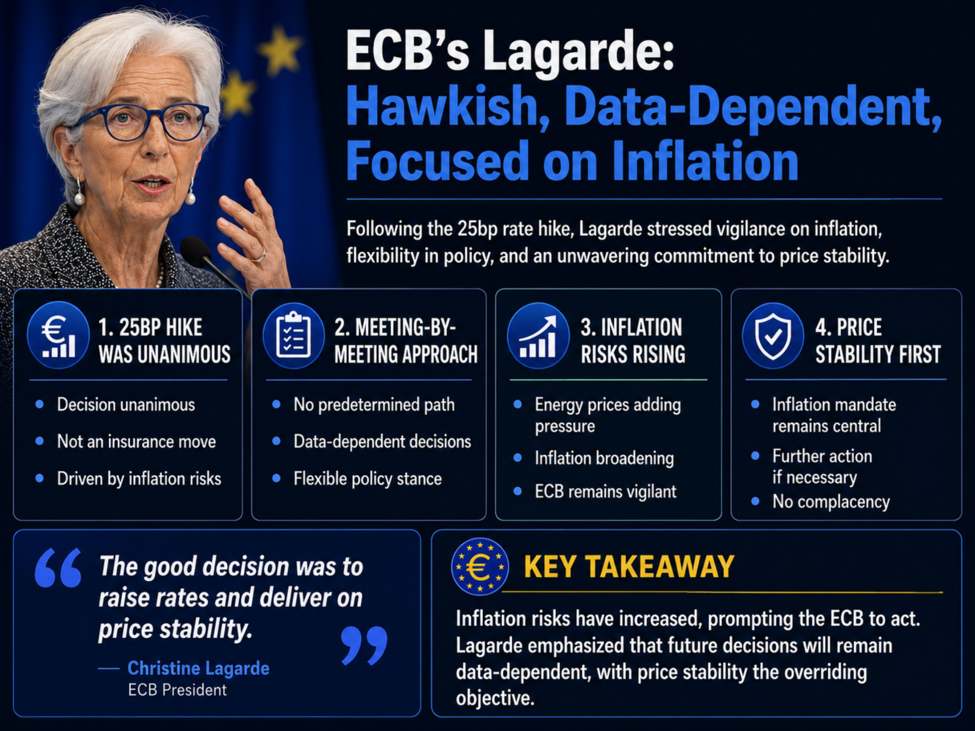
The ECB raised rates by 25 basis points as expected, and ECB President Lagarde delivered a hawkish message after the rate hike, arguing that acting now was necessary to preserve price stability amid rising inflation risks and heightened uncertainty. She emphasized unanimous support for the decision and said the greater risk was failing to act.
Lagarde noted that short-term inflation expectations have risen across several measures, while longer-term expectations remain broadly anchored near the ECB’s target. She acknowledged that inflation pressures are becoming more broad-based, partly due to higher energy prices and geopolitical tensions, but said there is still no convincing evidence of a wage-driven inflation spiral.
On growth, Lagarde pushed back against recession concerns, pointing to positive growth, rising incomes, and stronger consumer purchasing power. She stressed that the ECB remains data dependent and is not pre-committing to additional rate hikes, but made clear that policymakers remain focused on preventing inflation from becoming entrenched.
Overall, the message was that inflation risks remain elevated, the ECB is prepared to act when necessary, and policymakers are not ready to become complacent simply because inflation has recently been near target.
Technically, the ECB’s rate hike has done little to alter the bearish bias. The EURUSD remains below its falling 100-hour moving average, currently at 1.1541. Although the price briefly moved above that level during the European session, buyers were unable to sustain the momentum, and the pair has since rotated back to the downside.
As long as the price remains below the 100-hour moving average, sellers maintain the technical advantage. On the downside, the next key target zone comes around the 1.1500 level, between 1.1498 and 1.1506. A break below that area would open the door for a move toward the next swing area between 1.1442 and 1.1458. Beyond that, traders would focus on the year-to-date low from March 12-13 at 1.14089.
For buyers to regain control, they need to push the price back above the 100-hour moving average and hold it there. If that occurs, attention would shift toward a key resistance cluster between 1.1577 and 1.1587. This area includes former swing lows from May 20, the 61.8% retracement of the rally from the 2026 low at 1.15768, and the falling 200-hour moving average, currently near 1.1582. A sustained move above that resistance zone would strengthen the bullish case and target the 50% midpoint of the 2026 trading range at 1.16287.
In the video above, I outline the technical levels in play in greater detail and explain why.





Leave a Reply