

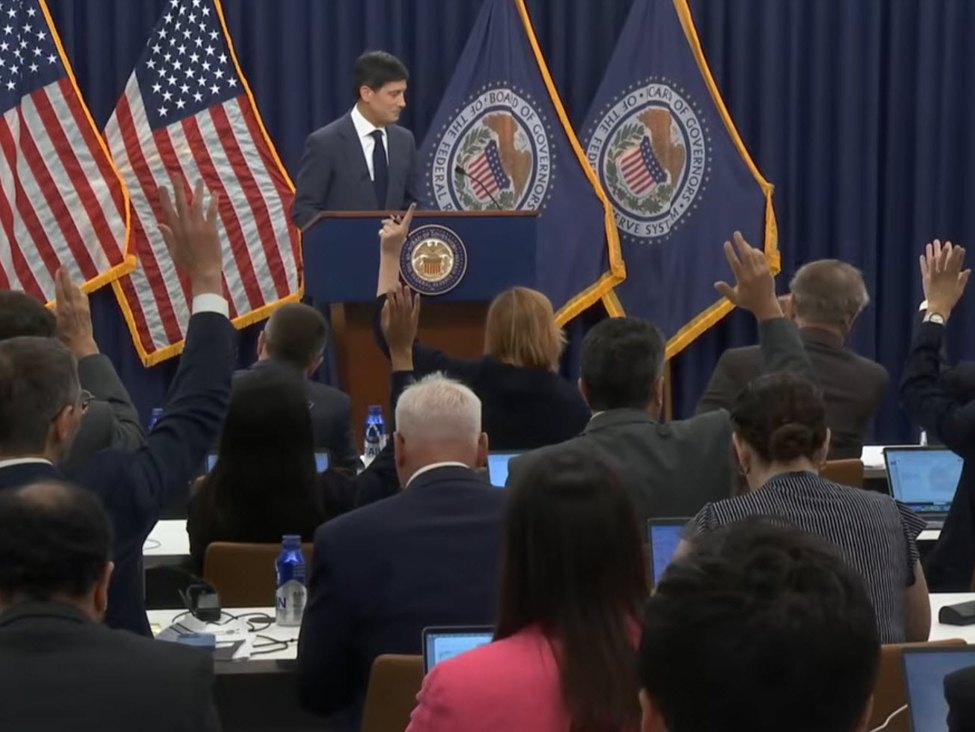
Fed Chair Warsh held rates at 3.5-3.75%, stripped cut-bias language from a shorter policy statement, skipped the dot plot, and announced five task forces to overhaul Fed operations including communications. Warsh said less and meant more, and markets are only beginning to price the difference.
Summary:
- The Warsh communication style, whether deliberate brevity or Greenspan-era deliberate opacity, may serve the same purpose: preserving Fed optionality by keeping markets guessing
- Forward guidance built on constant explanation has failed its most important test, with US inflation running at 4.2% and the 2% target unmet for five years
- A quieter Fed has historical precedent, from Volcker’s action-over-words approach to the era when rate decisions were not even announced
- The real signal from Warsh’s debut was not silence but compression: a hard, unambiguous commitment to 2% inflation that forecloses interpretation rather than inviting it
—
Kevin Warsh’s debut at the Federal Reserve podium on Wednesday lasted roughly 43 minutes and, by design, communicated remarkably little. That, it turns out, may be precisely the point.
The pundit class has largely received his performance as alarming. Markets accustomed to parsing every syllable from the Fed chair’s mouth, calibrating rate expectations to verbal nuance and interpreting the length of a pause as a policy signal, are understandably disoriented. But there is a serious counter-argument that the consensus has been too quick to dismiss, and it has historical company.
Alan Greenspan built an entire era of monetary authority on the practice of saying a great deal while meaning almost none of it. His famous formulation, that if you understood what he said he must have misspoken (“If I seem unduly clear to you, you must have misunderstood what I said.”), was not self-deprecating wit. It was a governing philosophy. Greenspan communicated constantly but in language so layered with qualification and conditional syntax that markets were perpetually uncertain which direction to run. That ambiguity was the tool. It preserved optionality, prevented front-running, and kept the Fed’s hand unreadable at precisely the moments when readability would have been most costly.
Warsh’s curtness is a different instrument aimed at a similar destination. Where Greenspan obscured through density, Warsh obscures through brevity. In several exchanges at Wednesday’s press conference he said simply that he had nothing more to offer than the statement itself, and that the committee had already done better than he could. The effect is the same: markets cannot trade the chair’s words because there are not enough of them to trade. Whether by elaboration or by silence, the Fed retains the initiative.
The more pointed historical parallel, though, is Volcker. He did not guide markets forward. He acted, and the actions spoke. The argument for saying less has a serious intellectual lineage that predates the entire forward guidance superstructure. The pre-1994 Fed (Greenspan was appointed in August 1987, served as Chair until January 2006) did not even announce rate decisions, leaving markets to infer policy from the mechanics of open market operations. Saying less preserved optionality and prevented markets from front-running policy in ways that blunted its effect. That argument did not disappear simply because Bernanke found it useful to talk more.
The entire architecture of modern Fed communication, the dot plot, the quarterly Summary of Economic Projections, the elaborately choreographed press conference, was built on a premise that has proven fragile: that central bank credibility is best maintained by explaining yourself constantly. The evidence of the past five+ years suggests otherwise. The Fed talked its way through an inflationary surge, repeatedly signalling patience while core PCE climbed well above target and stayed there. Consumer prices are still running at 4.2% annually. The 2% target has not been met in half a decade. That is not a record that vindicates the communication-heavy approach.
There is also a deeper point about institutional authority. A central bank that continuously explains what it will do, and then revises those explanations when circumstances shift, trains markets to trade the revisions rather than the underlying economic reality. Warsh’s refusal to submit his own dots is, in this reading, not a failure of transparency but a refusal to participate in a feedback loop that had become self-defeating.
What Warsh did say on Wednesday was unambiguous precisely because it was so compressed. The Fed’s commitment to 2% inflation was strong, unanimous and non-negotiable. The target was not under review and would not be until it had actually been achieved. That kind of language carries more genuine forward signal than a dot plot ever did, because it forecloses the interpretive game entirely. The five task forces announced to overhaul Fed operations, including a dedicated communications review, suggest this is architecture, not instinct.
The premise that more Fed communication is always better has had its test run. The results are on the CPI tape.
—



Leave a Reply