

Australia’s services PMI fell to 48.7 in May from 50.7, with new orders contracting at the fastest pace in two and a half years and employment falling for the first time since late 2024.
Summary:
Source: S&P Global Australia Services PMI, May 2026
- The services Business Activity Index fell to 48.7 in May from 50.7 in April, the second contraction in three months, with respondents citing reduced demand, market uncertainty and higher prices linked to the Middle East conflict
- New business declined at the sharpest pace in just under two and a half years, falling for a third consecutive month; new export orders also dropped for the second time in three months
- Employment fell for the first time since December 2024, ending a 17-month streak of job creation; the rate of decline was the sharpest since August 2021
- Input costs rose rapidly, driven primarily by fuel price increases attributed to the war; output price inflation was only fractionally below April’s 39-month high
- Business confidence fell to its lowest since November 2023, with optimists linking any recovery hopes to a potential end to the Middle East conflict, rising sales and AI development
- The Composite Output Index, covering both manufacturing and services, fell to 48.7 from 50.4 in April, with S&P Global warning the data suggest Australia will struggle to generate growth in Q2
Australia’s services sector contracted in May for the second time in three months, with new orders falling at their fastest pace in nearly two and a half years as the economic fallout from the Middle East war continued to squeeze demand and inflate costs across the economy.
The S&P Global Australia Services PMI Business Activity Index fell to 48.7 in May from 50.7 in April, dropping back below the 50.0 threshold that separates expansion from contraction. Survey respondents pointed directly to reduced demand, elevated prices and uncertainty linked to the ongoing conflict as the primary drivers of the deterioration.
New business volumes contracted for a third straight month, with the pace of decline the sharpest since late 2023. Export orders also fell for the second time in three months. The weakening demand environment prompted firms to cut staffing levels for the first time since December 2024, ending a 17-month run of employment growth. Though modest, the fall in headcount was the steepest since August 2021.
Cost pressures remain acute. Input costs continued to rise rapidly in May, with fuel price increases linked to the war cited as the dominant factor. The transport and storage sector reported the sharpest increases in both input and output costs of all five sectors monitored. Output price inflation eased only fractionally from April’s 39-month high, meaning firms are still passing elevated costs through to customers at a near-record pace.
Business confidence deteriorated further, falling to a two-and-a-half-year low. Among the minority expecting conditions to improve, the most commonly cited hope was an end to the Middle East conflict.
The services result compounds a weak manufacturing PMI released earlier in the week. The Composite Output Index, covering both sectors, fell to 48.7 from 50.4 in April. Andrew Harker, Economics Director at S&P Global Market Intelligence, said the combined picture suggested Australia would struggle to generate any growth across the second quarter as a whole.
—
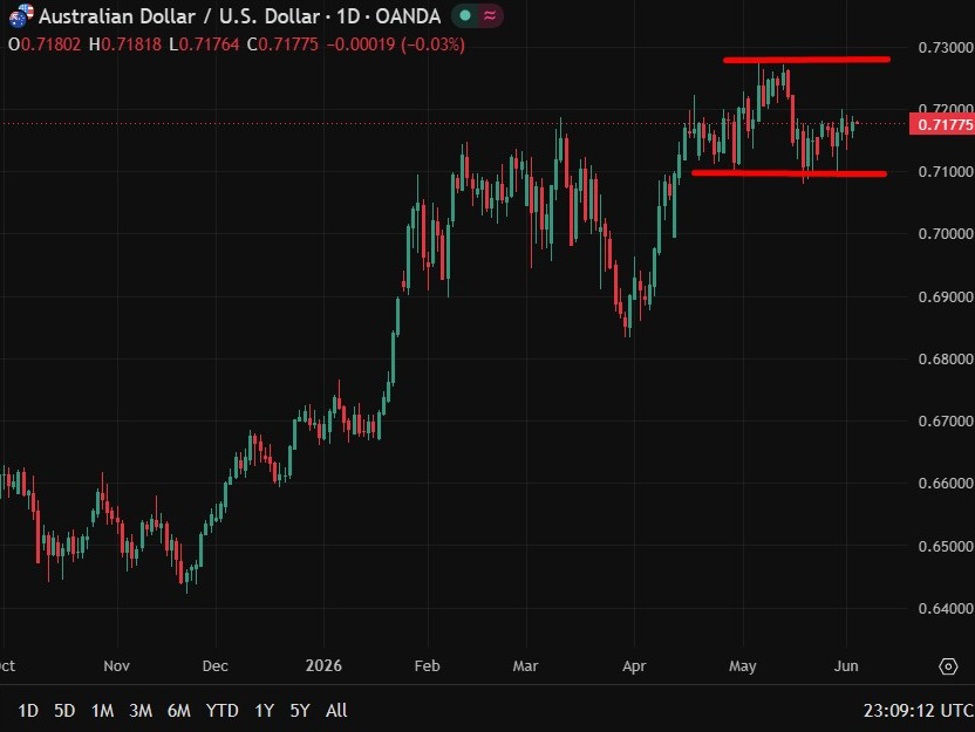
The back-to-back deterioration in both services and manufacturing PMIs puts meaningful downward pressure on RBA rate cut expectations, with elevated fuel-driven inflation complicating any dovish pivot just as the economy weakens. The explicit and repeated linkage of the slowdown to Middle East war costs underlines that Hormuz disruption is now transmitting directly into Australian business conditions, not just energy prices. For the Australian dollar, the combination of softening growth and persistent inflation is a difficult backdrop, particularly if the composite reading continues to track below 50 into Q3.





Leave a Reply