

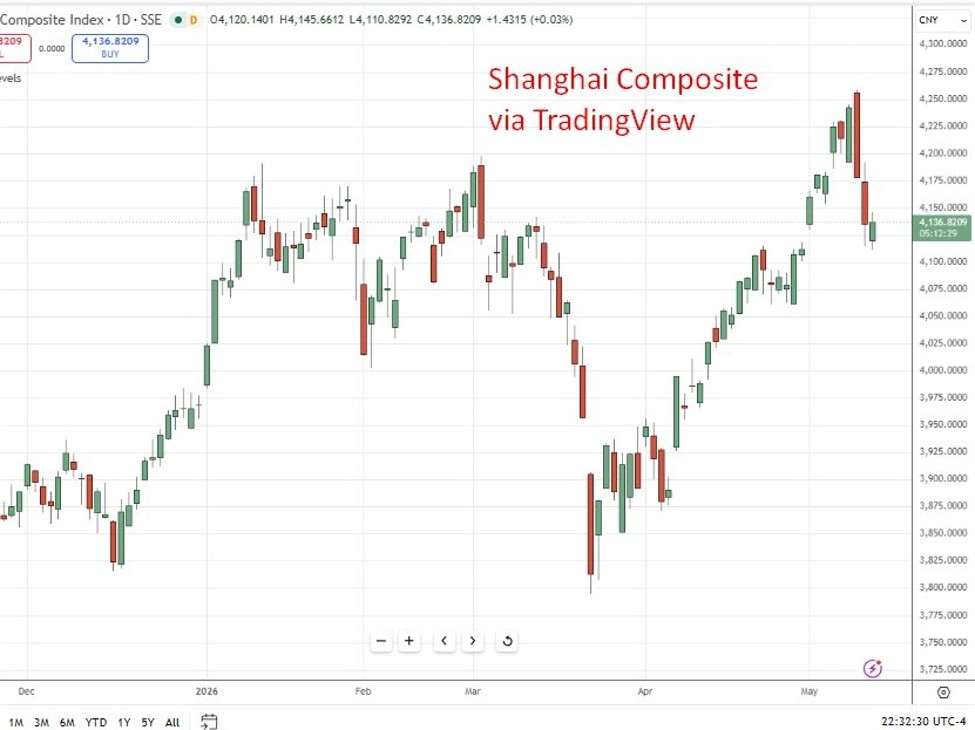
China’s April retail sales rose just 0.2%, the weakest since 2022, while industrial output grew only 4.1%, badly missing forecasts, as the Iran war and sluggish domestic demand weighed.
Summary:
- China’s National Bureau of Statistics reported April industrial output growth of 4.1% year-on-year, down from 5.7% in March and well below the 5.9% forecast, while retail sales rose just 0.2%, the weakest reading since December 2022, against a forecast of 2% growth, according to Reuters.
- Fixed-asset investment contracted 1.6% in the first four months of 2026, reversing a 1.7% rise in the January-March period, with domestic car sales falling 21.6% year-on-year for a seventh consecutive monthly decline.
- The NBS described the international environment as grim and complicated, called for more proactive fiscal measures and moderately accommodative monetary policy, and flagged a prominent domestic supply-demand imbalance, though the Politburo offered no concrete new stimulus beyond reiterating existing policy language.
- China’s economy expanded 5.0% in the first quarter, at the top of Beijing’s 4.5% to 5.0% full-year target range, but analysts warned the recovery was already running on uneven ground, with the Iran war adding external pressure to an economy still weighed down by a prolonged property market downturn.
China’s economy lost significant momentum in April, with industrial output and retail sales both badly missing forecasts, as the compounding pressures of higher energy costs from the Iran war and chronically weak domestic demand took hold.
Factory output rose 4.1% from a year earlier, a sharp deceleration from the 5.7% recorded in March and the slowest pace of growth since July 2023. The reading fell well short of analyst expectations centred on 5.9% growth. Retail sales, the primary gauge of household consumption, rose just 0.2% in April, cooling sharply from 1.7% in March and marking the weakest gain since December 2022, against a forecast of 2%.
The weakness was broad-based. Fixed-asset investment contracted 1.6% in the first four months of 2026, reversing a 1.7% expansion in the January-March period. Domestic car sales fell 21.6% year-on-year in April, a seventh consecutive monthly decline, even as Chinese automakers pushed harder into overseas markets to compensate for anaemic home demand. Property investment contraction also widened in April on an annual basis, extending a drag on growth that has persisted for several years.
China’s statistics bureau described the international environment as grim (THAT is VERY blunt!) and complicated, warning that global recovery momentum was facing greater headwinds. Officials called for more proactive fiscal policy and moderately accommodative monetary conditions, and acknowledged a prominent domestic supply-demand imbalance. However, the Politburo’s reiteration of existing policy language at its most recent meeting offered no signal of imminent additional stimulus, a point likely to disappoint markets seeking a more forceful response.
The April data offered an early indication that the economy’s 5.0% first-quarter expansion, which came in at the top of Beijing’s 4.5% to 5.0% full-year target range, may prove difficult to sustain. Better-than-expected exports and domestic fuel price controls have provided some insulation from the energy shock, but rising input costs and fragile consumption leave limited room for further slippage if the Iran conflict drags on.
—
The breadth of the April miss, spanning industrial output, retail sales and fixed-asset investment, signals that China’s first-quarter momentum was already fading before the Iran war’s full impact fed through. Weak domestic consumption combined with rising energy input costs is a particularly unfavourable combination for manufacturers, threatening to squeeze margins further and limit any export-led offset. The absence of concrete new stimulus signals from the Politburo, which reiterated existing policy language without announcing fresh measures, is likely to disappoint markets looking for a decisive demand-side response. For oil markets, a sustained slowdown in Chinese industrial activity represents a meaningful demand-side risk that could cap prices even as supply disruption continues.
Leave a Reply