

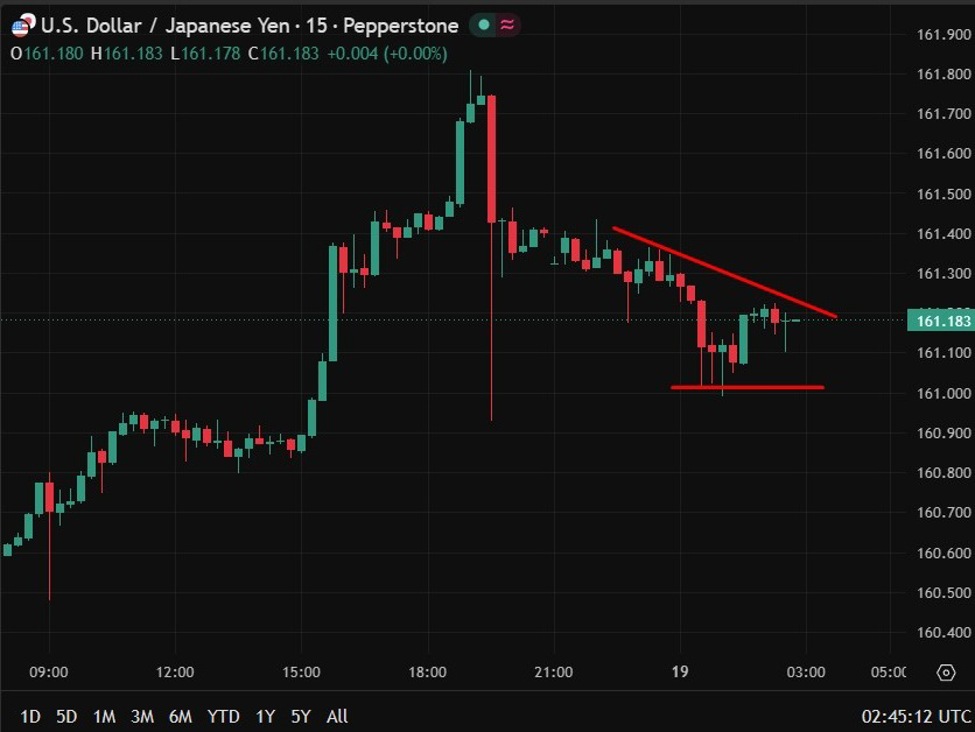
The data is dovish on the surface but the BoJ is unlikely to read it that way given the context. Subsidies are doing the work of keeping core below 2%, not underlying disinflation, and the PPI acceleration since March is the more forward-looking signal for where consumer prices are heading once government support tapers. For USD/JPY, the print offers no immediate catalyst for yen strength through a BoJ surprise, but Himino’s remarks on Friday about fuel costs intensifying around summer keep the next move in the rate cycle firmly priced. The yen’s weakness, averaging 158.24 in May and trading near 161 on Friday, is itself feeding the import cost pipeline the subsidies are trying to offset.
Earlier:
—
Japan’s core CPI held at 1.4% in May as expected, while core-core slowed to 1.8%, its weakest since September 2022, with government fuel subsidies masking pipeline inflation pressure.
Summary:
Per Japan Ministry of Internal Affairs and Communications, May CPI data released June 19:
- Headline CPI: 1.5% (expected 1.4%, prior 1.4%)
- Core ex fresh food: 1.4% (expected 1.4%, prior 1.4%) — below the BoJ’s 2% target for a fourth consecutive month
- Core-core ex fresh food and energy: 1.8% (expected 1.9%, prior 1.9%) — slowest since September 2022
- Government fuel subsidies were the primary factor suppressing the headline and core readings, with gasoline prices down 7% year-on-year and overall energy costs lower
- Producer price inflation has risen sharply since March, raising concern that business input cost increases will pass through to consumers in coming months
- The BoJ raised its benchmark rate to 1.00% earlier in the week and signalled continued gradual tightening; an overwhelming majority of BoJ watchers surveyed after the decision expect another hike by year-end
- More than 1,000 food and beverage products are scheduled for price increases in June, up from 84 in May, partly reflecting rising costs for chemicals used in packaging
Japan’s May inflation data landed on the soft side of expectations in headline terms, but the mechanisms keeping it there are temporary and the BoJ knows it.
Core consumer prices, excluding fresh food, held at 1.4% year-on-year, matching both the April reading and the median economist forecast. Core-core, which strips out both fresh food and energy and serves as the BoJ’s closest proxy for underlying inflation, slipped to 1.8% from 1.9%, its slowest pace since September 2022 and a touch below the expected 1.9%. Headline came in at 1.5%, marginally above the prior 1.4%.
In summary, the National CPI, May 2026:
- Core-core ex fresh food, energy: 1.8% | expected 1.9% | prior 1.9%
- Core ex fresh food: 1.4% | expected 1.4% | prior 1.4%
- Headline: 1.5% | expected 1.4% | prior 1.4%
The moderation in core-core reflects the direct effect of Prime Minister Takaichi’s subsidy programmes, which have kept fuel and utility costs artificially suppressed. Gasoline prices fell 7% in May from a year earlier. Strip those interventions away and the underlying picture is considerably less comfortable. Producer price inflation has accelerated sharply since March, driven by energy-related inputs, and that pressure has not yet fully migrated to the consumer level. When it does, the CPI prints will look different.
The forward signals are accumulating. More than 1,000 food and beverage products are scheduled for price increases in June, up from just 84 in May, driven partly by rising chemical costs in packaging. Services prices are picking up, with hotel stays among the categories seeing faster increases. Rice prices fell nearly 5% in May, providing some offset, but that relief is unlikely to persist.
The BoJ raised its benchmark rate to 1.00% earlier in the week, its highest since 1995, and Deputy Governor Himino used Friday appearances to warn explicitly that fuel cost pressure on CPI is likely to intensify around summer. Mizuho Securities chief economist Shunsuke Kobayashi captured the consensus view: the BoJ will continue normalising gradually if the outlook holds, but there is no sense of urgency. The subsidies are buying time. The question is what the data looks like when they are withdrawn.



Leave a Reply