

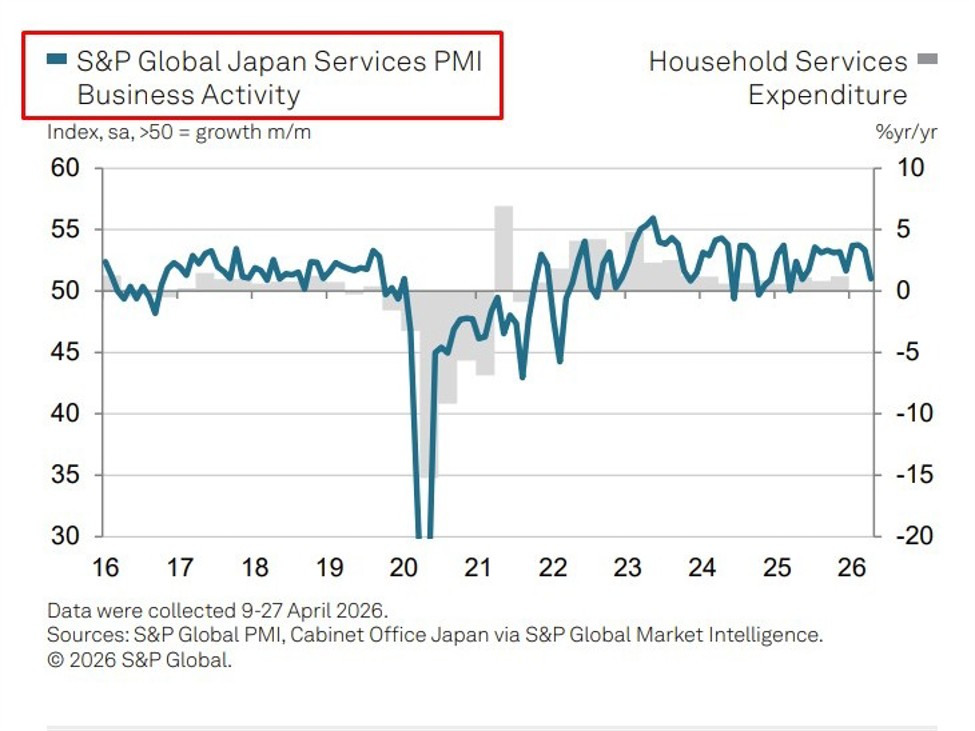
Japan’s services PMI fell to 51.0 in April from 53.4, an 11-month low, as Middle East war costs drove input inflation to a 42-month high and business confidence hit its lowest since the pandemic.
Summary:
- The S&P Global Japan Services PMI fell to 51.0 in April from 53.4 in March, marking the softest rate of expansion in 11 months and a 13th consecutive month of growth, according to S&P Global
- Input costs rose at the sharpest rate in 12 months in April, with the Middle East war cited as a key driver, particularly for fuel; output charges rose at the third-steepest rate since the survey began in September 2007, per S&P Global
- New orders expanded at the slowest pace since October 2025, with new export business falling for the first time in five months, partly attributed to war-related uncertainty weighing on overseas demand, according to S&P Global
- The Japan Composite PMI Output Index slipped from 53.0 in March to 52.2 in April, the softest reading of 2026 to date, with services weakness offsetting the quickest rise in manufacturing output in over 12 years, per S&P Global
- Input cost inflation across the composite hit a 42-month high in April, while selling prices rose at the fastest rate on record, suggesting an acceleration in official inflation in coming months, according to S&P Global Economics Associate Director Annabel Fiddes
- Business confidence was the second-lowest since the pandemic, lifting only marginally from March’s post-pandemic low, with ongoing uncertainty over the war and its cost and demand implications cited as the primary drag, per S&P Global
Japan’s services sector expanded at its slowest pace in 11 months in April, as the economic fallout from the Middle East war drove input costs to their highest in three and a half years and pushed business confidence to near its lowest level since the Covid-19 pandemic, according to the latest S&P Global Japan Services PMI survey.
The headline Services Business Activity Index fell to 51.0 in April from 53.4 in March, remaining above the 50.0 threshold that separates expansion from contraction and extending the current growth streak to 13 consecutive months. However, the pace of that growth was the most marginal since May 2025, and the data pointed to a services sector increasingly squeezed between weakening demand and accelerating cost pressures driven by the conflict in the Gulf.
New orders expanded at the slowest rate since October 2025, with firms reporting that uncertainty related to the war and elevated prices had weighed on sales. Export business fell for the first time in five months, albeit modestly, as overseas demand for Japanese services softened. Finance and insurance and transport and storage were the strongest-performing sub-sectors within the survey, but the broader picture was one of deceleration.
The cost picture was more alarming. Average input prices rose at the sharpest rate in 12 months, with fuel costs linked to the Middle East war cited explicitly as a key driver. Firms responded by passing on higher costs to clients, with output charges rising at the third-steepest rate recorded since the survey began in September 2007. S&P Global warned that the pricing data points to an acceleration in Japan’s official inflation rate in the months ahead, a development that will carry significant implications for the Bank of Japan’s policy path.
The composite picture, combining services and manufacturing, showed the Japan Composite PMI Output Index easing from 53.0 in March to 52.2 in April, its softest reading of the year to date. Strikingly, the composite masked sharply divergent sectoral trends: services growth was the weakest in months, while manufacturing output rose at the fastest rate in over 12 years, driven partly by front-loading as firms sought to build inventory buffers ahead of anticipated war-related supply disruptions.
Across the composite, input cost inflation hit a 42-month high and selling prices rose at the fastest rate on record, a combination that Annabel Fiddes, Economics Associate Director at S&P Global Market Intelligence, described as suggestive of a coming acceleration in official inflation. Fiddes noted that business confidence slipped to its lowest since the pandemic in August 2020, with firms citing the war, the risk of further price increases, and the possibility of softer customer demand as the primary sources of uncertainty weighing on their year-ahead outlook.
Employment continued to rise modestly across the services sector, at a pace broadly in line with March, and capacity pressures showed some signs of easing as backlog growth slowed to its softest rate in 14 months. But those relatively stable labour market signals sat in uncomfortable contrast with a confidence reading that is flashing a more cautious message about where Japanese services activity is headed as the Middle East conflict shows no sign of abating.
Bank of Japan Governor Ueda
—
The combination of slowing services activity and record-pace selling price inflation is a stagflationary signal that complicates the Bank of Japan’s policy calculus at a moment when markets are already pricing a June rate hike on the back of this morning’s wage data.
Input cost inflation hitting a 42-month high, driven explicitly by Middle East war-related fuel costs, is a direct transmission mechanism from the Gulf conflict to Japanese consumer prices, and S&P Global’s warning that official inflation could accelerate in coming months will add urgency to the BOJ’s deliberations. For energy markets, the data provides further evidence that the Iran conflict is generating measurable demand-side disruption in Asia’s second-largest economy, with business confidence at its lowest since the pandemic suppressing the kind of activity growth that would otherwise support fuel consumption. The divergence between a services sector slowing to its weakest in 11 months and a manufacturing sector posting its strongest output growth in over 12 years, partly driven by front-loading ahead of anticipated supply disruptions, creates an uneven demand picture that traders in both crude and refined products will need to navigate carefully.



Leave a Reply