

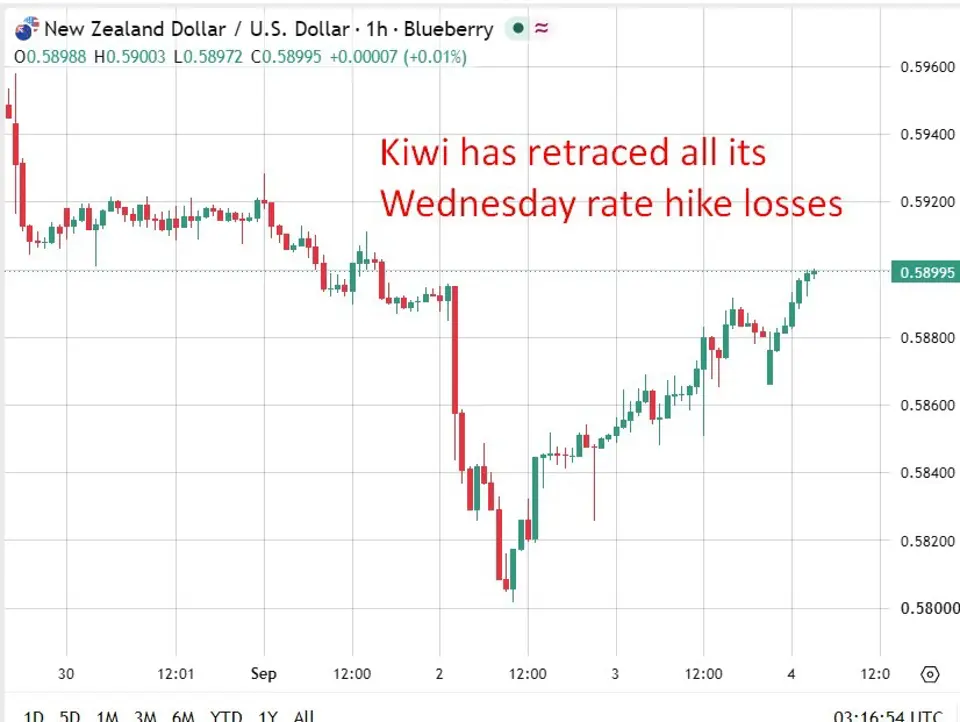
This week’s hike, the RBNZ’s second straight, was the widely expected part of the decision. The more market-moving element was the tone of the accompanying statement, which investors read as pushing the timing of the next move out to December rather than October. Swaps pricing has shifted accordingly, with only a 31% chance now attached to an October hike versus effective certainty of one by December. That repricing reflects a central bank still committed to further tightening in principle, but signalling it wants more time to assess the impact of the hikes already delivered before moving again. For NZD, the near-term read is a currency without a fresh, immediate hawkish catalyst, since the committee’s own framing argues against reading October as live, even as the medium-term tightening bias remains intact.
—
The RBNZ’s second hike this week came with a signal that the next one is more likely two meetings away than one.
Summary:
According to Bloomberg (gated), citing an interview with RBNZ Assistant Governor Karen Silk:
- The RBNZ raised the Official Cash Rate for a second straight meeting this week, with Governor Anna Breman saying a further increase is likely but that policymakers want time to assess the impact of the hikes delivered so far.
- The tone of that statement led investors to downplay the chance of an October hike and instead price in a move at the December meeting.
- Swaps data show just a 31% probability of a quarter-point hike to 3% in October, against effective certainty (100%) of that move being delivered by December.
- Silk said the rate track makes December more likely than October, though she stressed the RBNZ is not on a pre-determined path and would adapt if data or conditions shift.
- The RBNZ now expects headline inflation, currently forecast at 3.9% by the end of 2026, will not return to the 2% midpoint of its 1-3% band until early 2028, later than previously projected.
- Silk was one of four of the six-member Monetary Policy Committee to flag upside inflation risks, citing potential Middle East-driven fuel and freight cost pass-through, firms using the recovery to raise prices, and persistent non-tradable inflation in areas like insurance and electricity.
New Zealand’s central bank raised the Official Cash Rate for a second consecutive meeting this week, but investors have come away pricing its next move for December rather than October, according to Bloomberg, which interviewed RBNZ Assistant Governor Karen Silk in Wellington on Friday.
Governor Anna Breman said following the decision that a further rate increase is likely, but that policymakers want time to assess how the increases delivered so far are flowing through the economy. That framing shifted market expectations meaningfully: swaps data now show only a 31% probability of a quarter-point hike to 3% at October’s meeting, compared with an effective certainty that the move will have happened by December. Silk told Bloomberg the committee was clear further tightening is likely conditional on the outlook, and that while the timing remains open, the current track makes December “more likely than” October.
Silk was careful to frame that lean as a reflection of the current data track rather than a locked-in decision, saying the RBNZ needs to “think flexibly” and adapt if incoming data or conditions change.
The decision comes as the RBNZ pushes back its own inflation timeline. The bank now sees slightly faster inflation through 2027 and no longer expects headline inflation to return to the 2% midpoint of its 1-3% target band until early 2028, later than previously forecast. At the same time, the central bank is watching a recovery it sees as uneven, with exports and tourism leading while household spending and investment remain cautious. Silk described the position as a delicate balance between supporting that recovery and guarding against inflation pressure, saying policymakers were weighing how much tightening to deliver now against the risk of needing to do more, and faster, later.
Silk was one of four members of the six-person Monetary Policy Committee to flag upside risks to the inflation outlook, which currently sees inflation remaining at 3.9% through the end of 2026 before easing to 2.1% a year later. She cited three specific risks: the potential for the Middle East conflict to persist and feed through into fuel prices, freight costs and other second-round effects; the risk of firms using the economic recovery as cover to raise prices; and the persistence of non-tradable, domestic inflation in areas the RBNZ has limited influence over, including insurance, electricity and land taxes. Despite flagging those risks, the Monetary Policy Committee did not require a formal vote to reach this week’s decision, and Silk said she did not consider the risks strong enough to warrant a different view from the rest of the committee.

Leave a Reply