

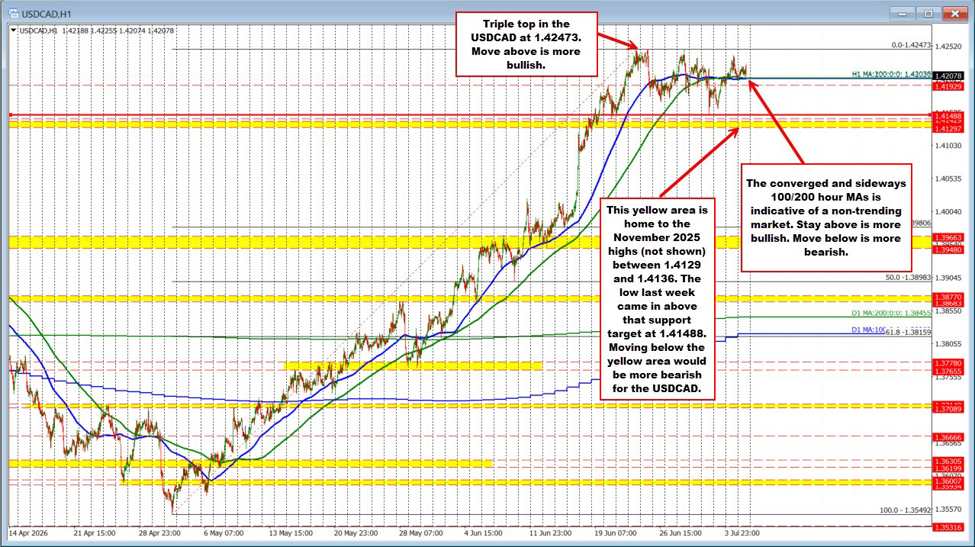
The USDCAD has been one of the strongest trending currency pairs since May 1, rallying from a low of 1.35492 to a peak of 1.42473, a level that capped advances on June 24, June 25, and June 30. Since that triple-top formed, however, the pair has shifted from trending to consolidating.
Over the past two weeks, USDCAD has traded within a relatively tight 100-pip range between 1.41488 and 1.42473. Sitting near the middle of that range are the converged 100-hour and 200-hour moving averages, both currently near 1.4203. The fact that both moving averages are flat and overlapping is a classic sign of a market that has lost its directional momentum. Since June 22, price action has reflected that, with buyers and sellers taking turns but neither side able to establish lasting control.
Looking at today’s trading, the pair briefly dipped below the converged moving averages, reaching a session low of 1.4200. That break proved short-lived, with buyers quickly stepping back in to push the price back above both indicators. Even so, the recovery has lacked conviction. The session high reached only 1.4226, leaving today’s trading range at just 26 pips. The pair currently trades near 1.4208, still hovering close to those key moving averages.
From a technical standpoint, the 100-hour and 200-hour moving averages remain the line in the sand. As long as the price stays above them, the short-term bias tilts in favor of the buyers. The triple top at 1.4247 becomes the next obvious target. Conversely, a sustained move back below those levels would shift the near-term bias to the downside.
For the sellers to gain stronger control, however, they would need to push the pair below the more important support zone between 1.4129 and 1.41488. That area is reinforced by the swing highs from November 2025 (between 1.4129 and 1.4136 – not shown) as well as last week’s swing low at 1.41488. A break below that support would increase the bearish bias and open the door for a deeper corrective move.
Until then, the market remains stuck in consolidation, waiting for the next catalyst to produce a decisive breakout





Leave a Reply